


"
115,446 generation records, 108 folders, more than 40,000 prompts—the entire production process behind a 95-minute AI film, laid out for you to see
— Koka
Hello everyone, I’m Koka.
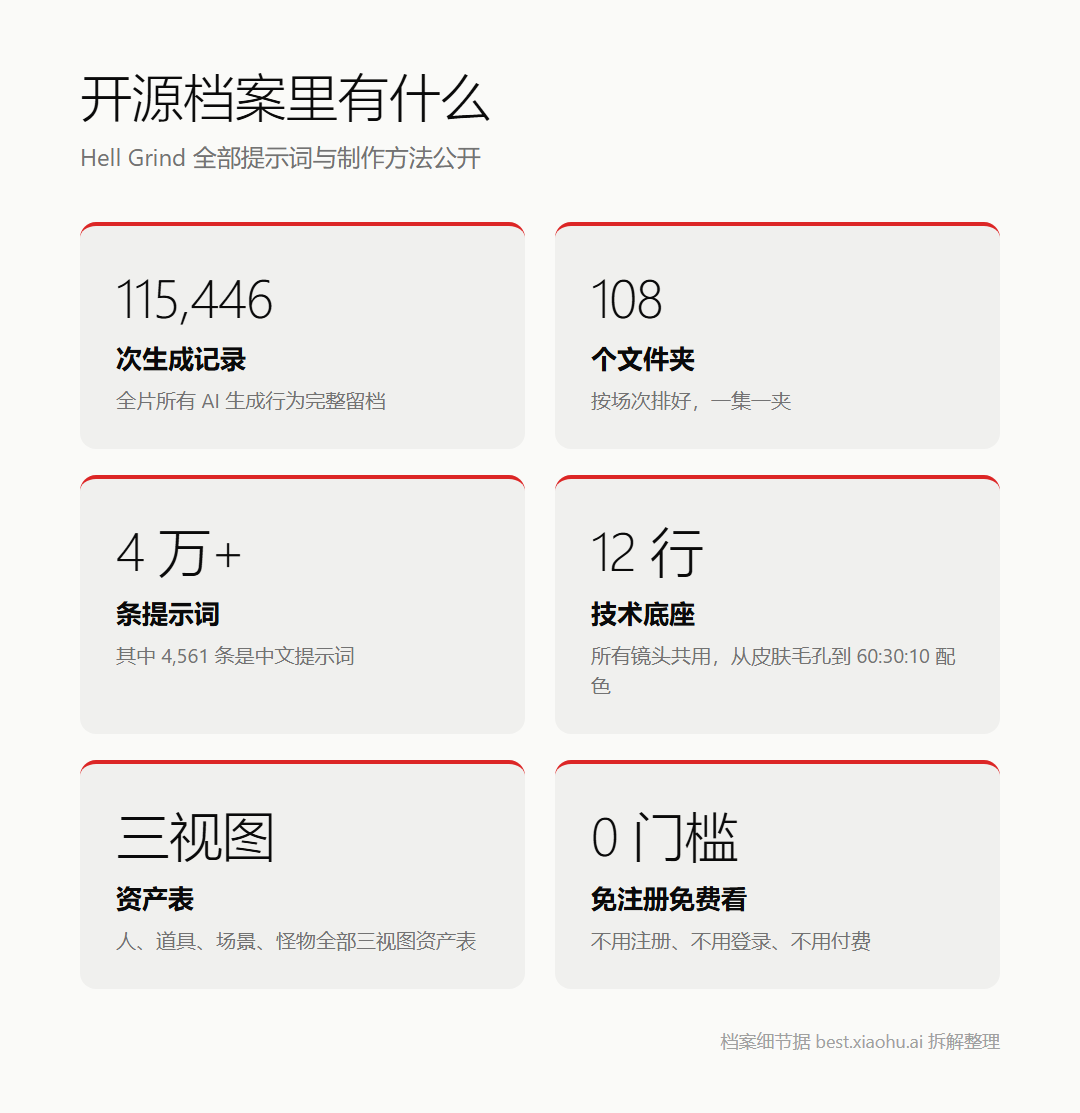
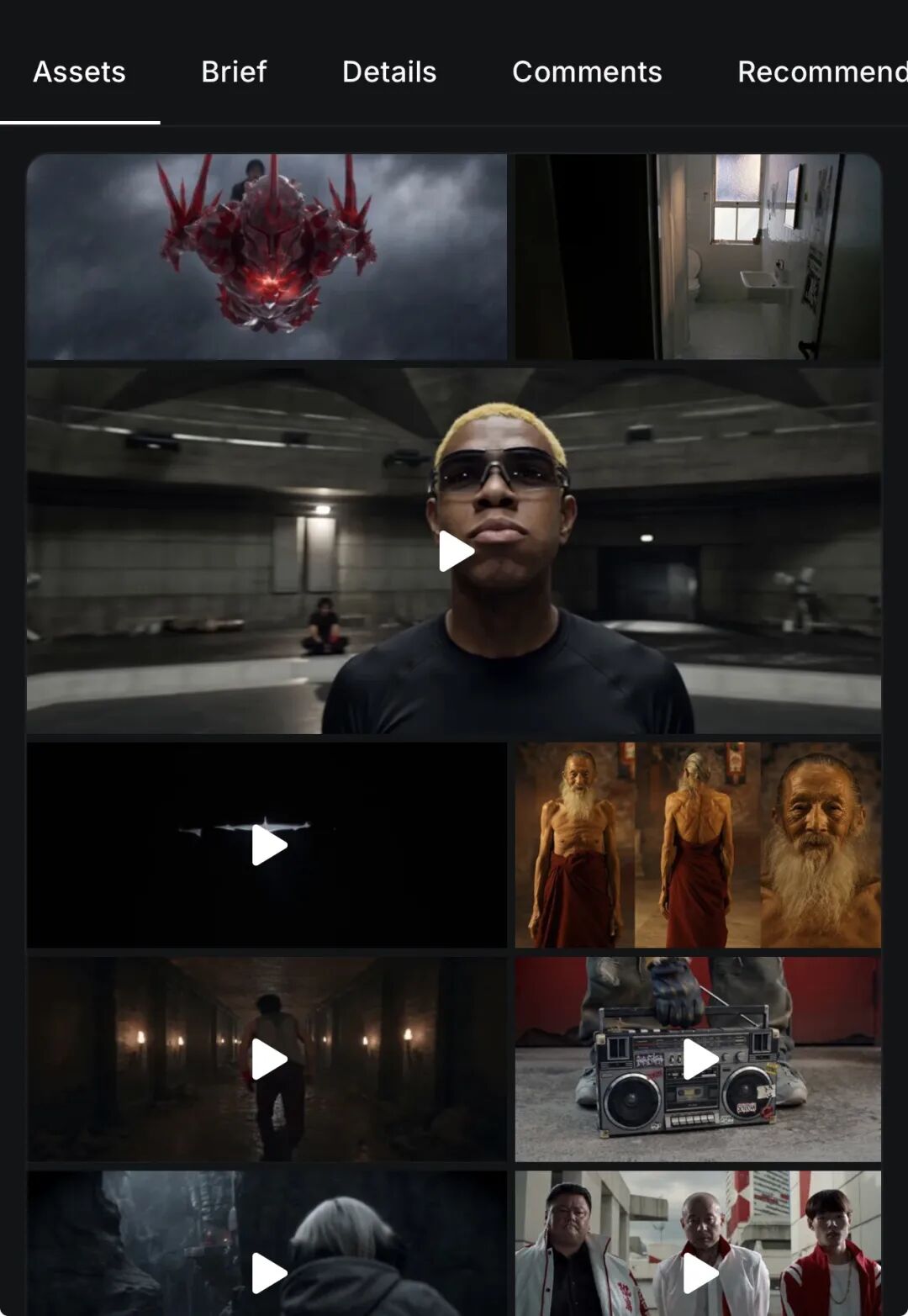
Recently, Higgsfield open-sourced the complete package of prompts, production processes, and assets for their $500,000, 95-minute AI feature film 《Hellgrind》. I can hardly believe they made all of this freely available. There are 115,446 generation records organized by scene in 108 folders, along with more than 40,000 prompts. Of these, 4,561 are Chinese prompts. You can open and view everything without registering, logging in, or paying.
Video source: excerpts from 《Hellgrind》
— What’s in the open-source archive
01
FILM
First, some background on the film
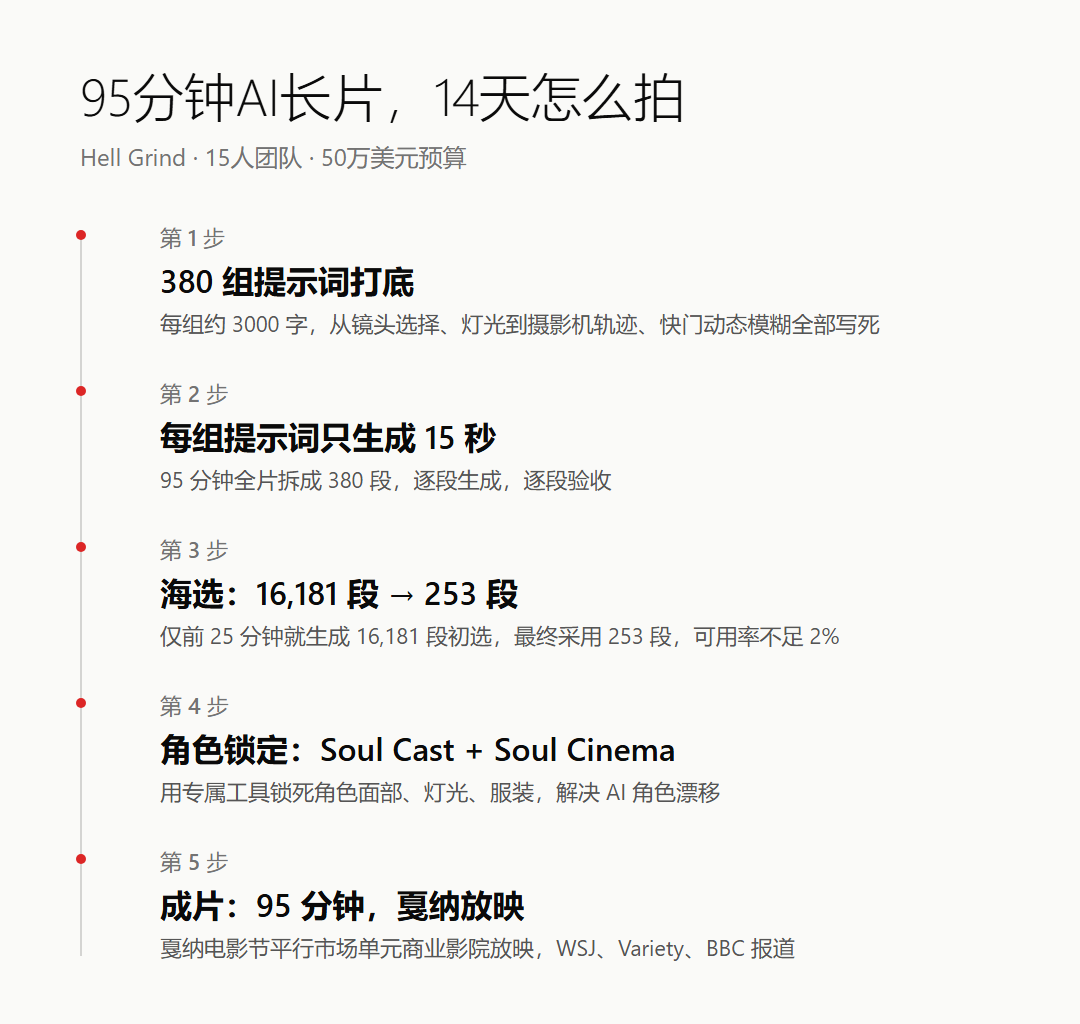
《Hell Grind》is a 95-minute AI-generated fantasy action feature. Honestly, if you didn’t tell me, I wouldn’t be able to tell it was made with AI. A 15-person team completed it in 14 days, with a $500,000 budget: $400,000 went to cloud GPU computing, and $100,000 went to labor and editing. The story follows four street thieves who accidentally trigger an ancient artifact while stealing, sending one of them into the mythological underworld.
The film was screened in a commercial theater rented in the parallel market section during the Cannes Film Festival, and was covered by The Wall Street Journal, Variety, and the BBC. Frankly, you can count the AI feature films that have been screened at Cannes on two hands. It is among the projects leading the field.
— The production pipeline for a 95-minute AI feature
02
PROMPTS
380 prompt sets, 3,000 words each, for just 15 seconds of footage
The most staggering thing in the open-source archive is the scale of the prompts. The entire 95-minute film was divided into 380 prompt sets, averaging 3,000 words each. Everything from shot selection, lighting setup, and camera movement to shutter motion blur was specified in detail. Each prompt set could generate only 15 seconds of footage.
Do you know how extreme that is? Writing prompts went from casually typing a sentence to the intensity of writing a storyboard script. When we used to talk about AI video prompts, it was “a cat sunbathing on a balcony.” Here, it is a 3,000-word on-set shooting directive—and you can copy all of it.
Even more incredible is the generation efficiency. In just the first 25 minutes, they generated 16,181 initial video clips, of which only 253 were ultimately used—a usable rate of under 2%. That’s what professional production looks like: 98% of the footage was discarded. This isn’t generation; it’s a casting call, a documentary-scale battle of material consumption.
“380 prompt sets, 3,000 words each, for just 15 seconds of footage”
03
ARCHIVE
Those 12 lines of technical foundation in the archive are the truly valuable part
Honestly, having lots of prompts isn’t unusual. What’s unusual is how the archive is organized. Every shot shares the same 12-line technical foundation, covering everything from skin-pore details to a 60:30:10 color scheme. Copy it, and you can use it immediately. Characters, props, settings, and monsters all have three-view asset sheets.
These 12 lines are essentially the entire crew’s technical constitution. No matter which scene is being shot, those 12 lines are added first to ensure that every shot exists within the same technical world. The biggest pain point in AI features is character drift: a face that looks normal one second can fall apart as soon as the lighting changes. Higgsfield used this foundation, along with its proprietary Soul Cast and Soul Cinema character-locking tools, to keep the problem under control.
Let me put it this way: in the past, when learning AI filmmaking, you could only look at the finished product and guess how it was made. Now they have laid out the raw footage, discarded footage, prompts, and asset sheets for you to see—even the failures are educational material.
04
OPEN SOURCE
What’s open-sourced isn’t just files, but an entire set of validated ways to fail
I’ve always felt that the most valuable part of this isn’t the 380 prompt sets themselves. It’s that they put the failure rate of AI features right in front of us. Of the 16,181 pieces of footage, only 253 were kept. Ordinary people might be discouraged immediately by that number, but anyone who seriously wants to make something will see it as tuition.
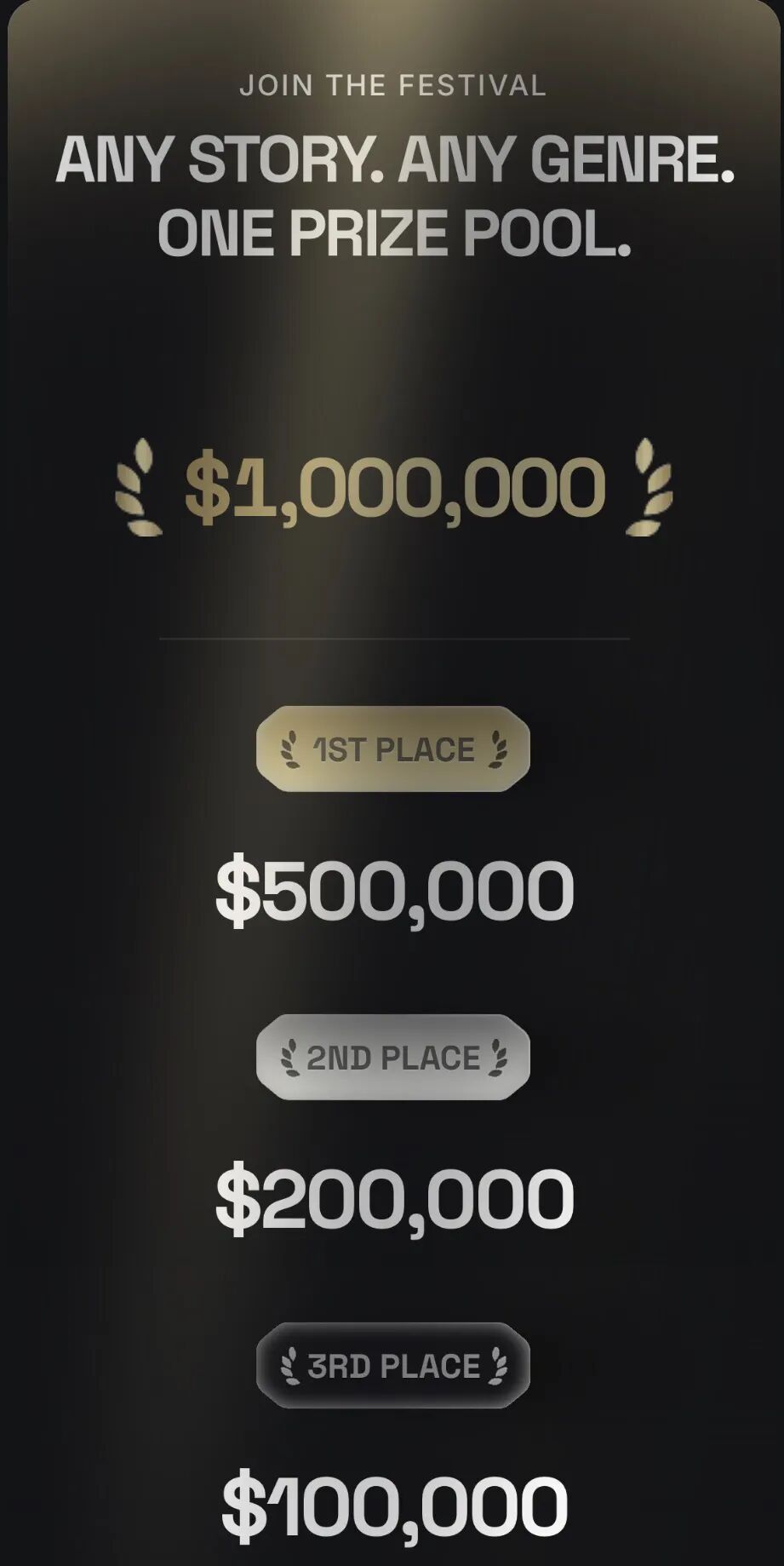
Higgsfield also launched a global AI film festival with a $1 million prize pool. Entries must be at least 3 minutes long and generated entirely with their Cinema Studio. The first-place prize is $500,000. In other words, it open-sources a method, then offers money to invite people around the world to make films with it.
What can I say? It’s a pretty clever approach. Open source solves the trust problem, the competition solves the participation problem, and in the end, the prompts and generation histories of all entries will be made public—effectively having creators around the world work for free to provide its training data. The loop is designed quite beautifully, but you can indeed get a complete, validated method from it.
∞
THE END
A step-by-step guide for copying the homework is finally on the table
Returning to the question at the beginning: we used to find even a 30-second AI short film difficult, while they made a 95-minute film in 14 days. Now they have even given you the homework to copy.
Whether AI features can become an industrial workflow, I’m not sure. But at least someone has taken the first step, and done so with remarkable transparency. What remains is to see whether someone is willing to spend three months following this archive to make a 10-minute film from start to finish. If you have a story you want to film, this archive is worth a look.
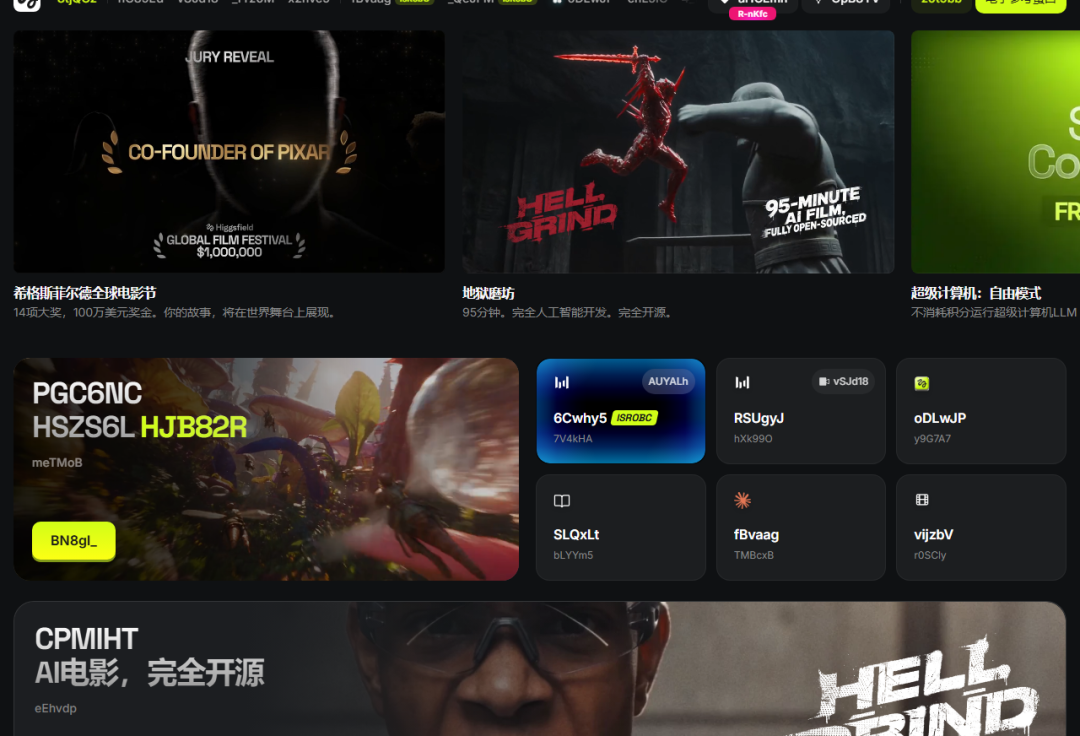
The open-source archive can be accessed directly at higgsfield.ai.
— Higgsfield official website