

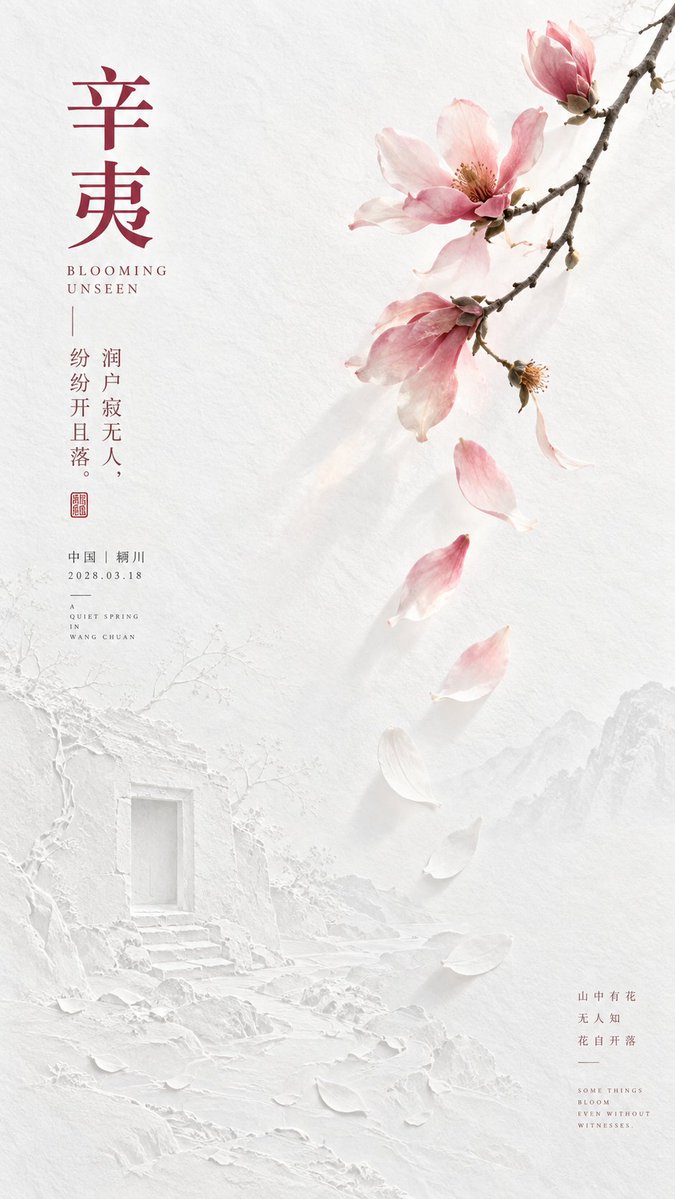
Prompt
Create a 9:16 vertical Eastern poetic minimalist art poster.
Do not directly recreate the complete classical scene from 【original poem lines】. First identify the poem’s most distinctive 【poetic dominant color】, then let that color carry the emotion and narrative through the 【core subject】 and 【color transformation】.
Use near-white premium handmade art paper with delicate fibers and natural impressions, leaving about 65%–75% open space. Keep the subject small and clear; do not create impact with full-frame landscapes, oversized figures, or excessive elements.
The color must have a source. Examples include rouge pink from flowers, cinnabar orange from sunset, emerald green from mountain moisture, and amber gold from farewell wine and paths of light. Concentrate color in about 10%–20% of the image; keep the rest pure white, pale gray-white, and low-contrast textures.
Let the color transform, for example:
Colored petals gradually fade into white bas-relief;
the sunset retains only one warm-orange dot;
transparent moisture reveals emerald green only after touching clothing and stone;
warm golden light crossing a mountain pass gradually fades back to pure white.
Add white bas-relief related to the theme, showing vanished paths, flower traces, ridgelines, footprints, old city walls, or human traces. Keep it clean from afar, with hidden information revealed up close.
People are optional. Add a tiny figure only when scale is needed; when the poem emphasizes “无人” (“no one”), “远行” (“traveling far”), or “离开” (“leaving”), suggest human presence through an empty gate, wine cup, hoofprints, or an old road.
All waterlines, light paths, moisture, petal trails, and roads must be continuous, soft, and natural. Avoid numerous breaks, fragmented lines, and chaotic AI textures.
Use 【two-character theme】 as the main title, with concise poetic lines, 【place】, 【date】, and an 【English subtitle】 in a modern Song, Ming, or premium Chinese serif font. Keep the typography accurate, concise, and editorial.
Overall:
Wang Wei’s poetic mood × expansive Eastern whitespace × premium handmade paper × white bas-relief × one poetic color × small subject × Editorial Design.
The goal is not to “colorize” a classical poem, but to make color itself part of the poetry.