


For a newly launched website, the most frustrating thing is this: you publish a ton of content, but Google still doesn't index it.
In fact, slow indexing is normal for new sites—Google puts new domains under observation and allocates them very little crawl budget. But that doesn't mean you can only sit around and wait. The following 7 practical tips can help you make the most of your limited crawl resources and genuinely speed up indexing.
1. Configure robots.txt precisely—don't waste your crawl budget
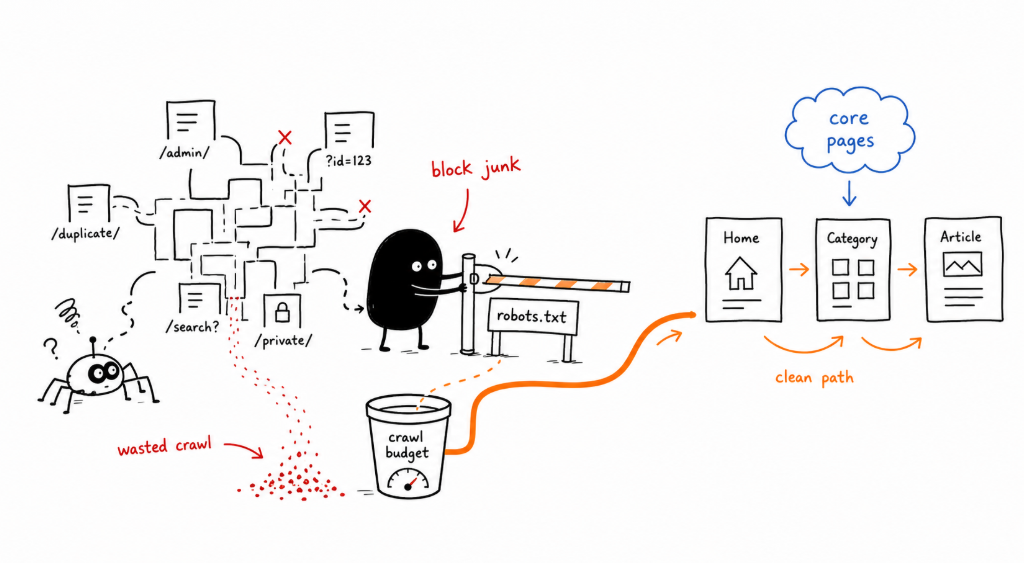
Many new webmasters overlook the importance of robots.txt. It is the first file search engines check before crawling your website, and it determines which pages spiders can and cannot access.
❌ Wrong approach: Randomly copy a robots.txt file, or don't set one up at all, causing spiders to crawl large numbers of useless pages (admin pages, duplicate content pages, parameter pages) and waste valuable crawl budget.
✅ Right approach: Follow these three principles—
•Block admin pages, privacy pages, and duplicate content pages
•Prevent spiders from crawling invalid paths and focus resources on core content pages
•Regularly use the robots.txt testing tool in Google Search Console to prevent accidentally blocking important pages
2. Keep your server stable and reliable—the website's “lifeline”
The server directly affects two things: the user access experience and the crawling efficiency of search engine spiders.
If your website is frequently inaccessible or loads slowly, it will not only drive users away; Google will also actively reduce its crawl frequency and may even suspend crawling in serious cases—this is fatal for a new site.
Recommendations:
•Prioritize reputable cloud service providers (Alibaba Cloud, Tencent Cloud, AWS, etc.)
•Use CDN acceleration to improve access speeds worldwide (especially important for international websites)
•Monitor server status and address outages promptly
3. Keep your website structure simple and clear, so spiders can “follow a straight line”
A good website program should not only offer excellent performance but also be secure and reliable. Many websites perform well during the early stages of optimization, only to be hacked or infected with malware, causing the site to be K'd and all their efforts to go to waste.
Points to note:
•Avoid using overly common mass-market templates whenever possible (they are easy targets for large-scale attacks)
•Keep URL depth within 2–3 levels; excessive depth is not conducive to crawling
•Maintain a clear, logical structure that is easy for users to browse and search engines to understand
4. High-quality original content is the key—don't be a “content scraper”
“Content is king” is not just a slogan. High-quality original content is both a powerful way to attract users and a core basis for Google to assess a website's value—especially after the Helpful Content updates, leaving increasingly less room for scraped and pieced-together sites.
Five directions for content optimization:
Direction | Key point
Originality | Eliminate plagiarism and create unique content
Practicality | Solve users' actual problems
Scarcity | Offer unique perspectives or exclusive information
Update frequency | Update regularly to develop a habit of spiders visiting your site
Conversion focus | Ultimately serve business conversion rather than being written solely for SEO
5. The homepage is the spider's “golden entrance”—don't waste it
The homepage has the highest authority across the site and is also the place spiders visit most frequently. Using homepage resources effectively can significantly speed up the indexing of new content.
Optimization suggestions:
•Add a “Latest Articles” section to the homepage so new content gets a crawling opportunity as soon as it is published
•Place links to key sections strategically and pass authority to core pages
•Improve the homepage's readability and guidance—it should serve both users and search engines
6. Focus on quality rather than quantity when building backlinks, and avoid pitfalls
Although the influence of backlinks has weakened year by year, for new sites, high-quality backlinks remain an effective way to earn Google's trust and increase crawl frequency—they are essentially “votes of confidence” from other websites.
Points to note:
•Backlink platforms should have a certain level of authority and industry relevance
•Stay away from spammy backlinks and buying or selling links; otherwise, you may trigger Google's spam link algorithms (Penguin / SpamBrain), causing more harm than good
•Control the number of outbound links on each page to prevent authority from being diluted
7. Build natural, smooth internal links to keep spiders “inside” your site
Internal links can improve the user experience while guiding spiders to crawl deeper into your website's content. However, most new sites have problems with missing internal links or awkward link stuffing.
Internal linking tips:
•Add a “Related Articles” section at the bottom of articles
•Naturally insert links to related content within the body text
•Don't force it—relevance and readability should always come first
In conclusion
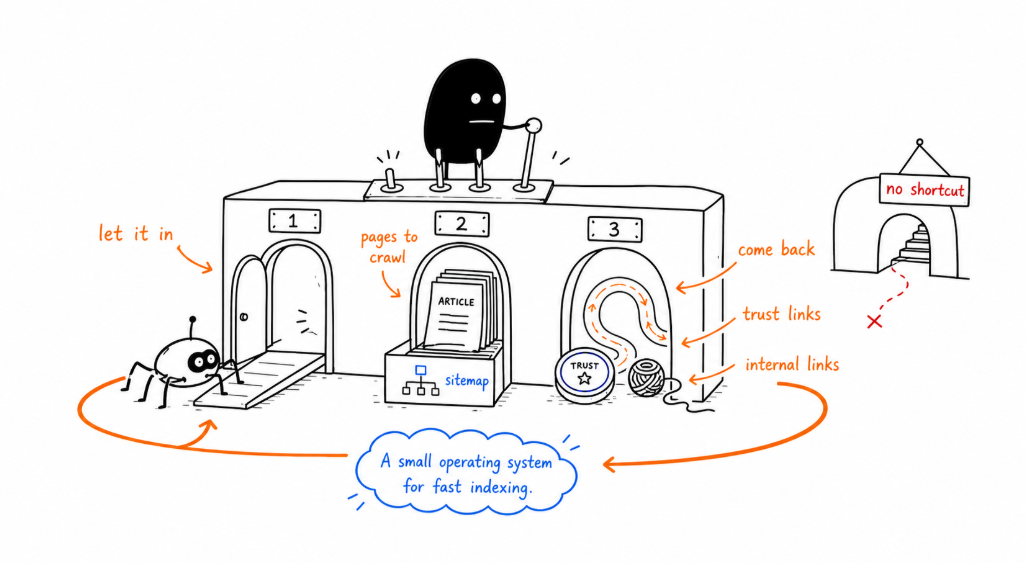
There is no shortcut that guarantees immediate indexing for a new site. At its core, it comes down to three things:
1. Make it possible for spiders to get in (robots.txt, server, and structure)
2. Give spiders something to crawl (original content and homepage entry points)
3. Give spiders a reason to come back regularly (backlink trust and internal link guidance)
Implement these 7 points one by one, and submit your Sitemap proactively through Google Search Console. Most new sites can see a significant improvement in indexing within 1–2 months.