

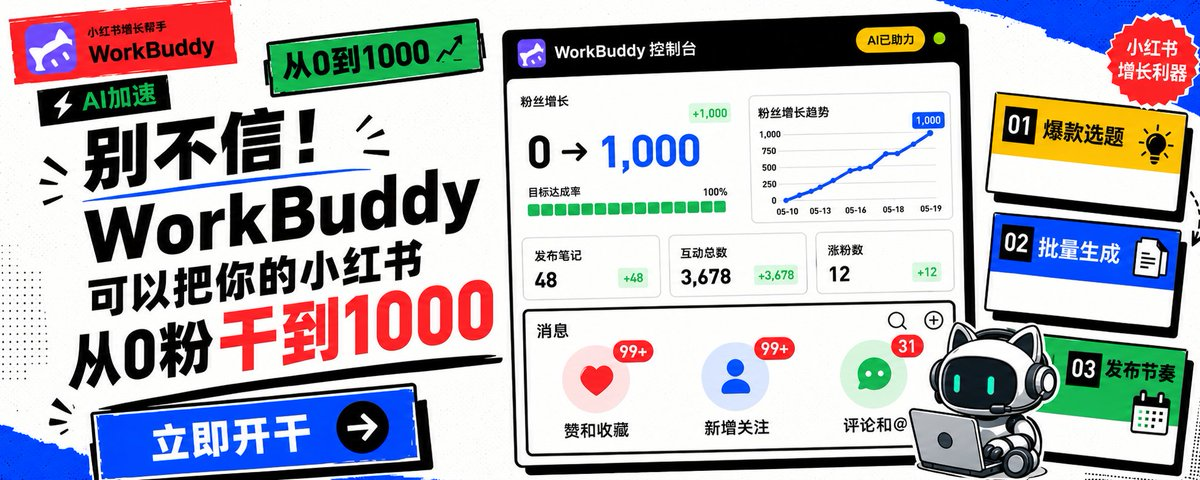
WorkBuddy XHS Skills is not merely a set of prompts for generating Xiaohongshu copy. It is a content operations workflow that can be installed in Codex, Claude Code, or WorkBuddy. It works backward from monetization goals to determine account positioning, then turns that positioning into an account profile, topic bank, publishing plan, individual posts, and review experiments.
The project's focus is not having AI mass-produce marketing copy. It is building a content system that increasingly resembles the creator and better understands the account's direction through continuous publishing, data tracking, and hypothesis refinement.
What Problems Does the Project Solve?
If you are creating a Xiaohongshu account from scratch, or already have an account with a scattered focus and little personal character, this workflow lets an Agent assist with operational decisions in stages. A complete workflow usually includes the following deliverables:
- Positioning and monetization path: Define the target audience, core problem, reasons to trust you, and potential future offers such as consulting, courses, or other products.
- Account profile: Document your tone, real experience, credible claims, and content and visual boundaries.
- Sample analysis: Analyze the click, retention, and engagement mechanisms behind recent high-performing posts from low-follower accounts.
- Topics and titles: Generate more than 35 structured topics, along with title formulas, cover directions, and priorities.
- Publishing plan: Plan the first 10 posts and a 7-day or 30-day publishing rhythm.
- Post optimization: Diagnose AI-like language, preserve authentic opinions, and organize the post into a 6- to 8-page visual-text structure.
- Data review: Distinguish effective from failed hypotheses and define adjustments for the following week.
The reading and engagement data shown in the README indicates that this approach comes from real content operations, but the project explicitly states that its examples do not guarantee follower growth, traffic, or monetization results.
Meet the Six Skills
The project divides the operations process into six coordinated Skills. Understanding their responsibilities helps you choose the right starting point.
1. Work Backward from Monetization to Positioning
wb-xhs-monetization-backsolve is for the stage when you do not know what kind of account to create or what you may eventually sell. It organizes monetization paths, a positioning card, a content matrix, and a 10- to 20-post validation plan.
2. Build an Account Profile
wb-xhs-account-profile addresses AI output that does not sound like you and inconsistent account messaging. Its core deliverables include language samples, credible claims, personal experience, and content and visual boundaries.
3. Analyze High-Performing Samples from Low-Follower Accounts
wb-xhs-low-follower-pattern helps you select recent samples and diagnose the click drivers in covers and titles, the retention drivers in the body, and the reasons behind saves and comments.
4. Create a Topic Bank
wb-xhs-topic-bank is for situations where you lack topics, titles, or cover hooks. It can organize ideas around pain points, numbers, comparisons, scarcity, resonance, resources, and counterintuitive insights.
5. Humanize Drafts and Check Compliance
wb-xhs-humanize-compliance handles drafts that are too polished, vague, or templated. It delivers an AI-style diagnosis, humanized revision, publishing checklist, and page-by-page visual-text breakdown.
6. Schedule and Review
wb-xhs-schedule-review plans the first 10 posts, builds a data dashboard, reviews positioning, and designs the following week's experiments. It can be used for early planning on a new account or called again after a publishing cycle.
Installation and Setup
First download or clone the project locally, then enter the repository root containing the six wb-xhs-* directories. Next, copy the Skills according to the Agent tool you use.
Install in Codex

cp -R wb-xhs-* ~/.codex/skills/Install in Claude Code
cp -R wb-xhs-* ~/.claude/skills/After copying, restart the corresponding application so the newly installed Skills are reloaded. Each Skill directory contains SKILL.md and test-prompts.json: the former describes the capabilities available to the Agent, while the latter provides trigger, boundary, and regression test cases.
The project also targets WorkBuddy, but the README's direct copy commands only cover Codex and Claude Code. When using another environment, configure it according to that tool's Skill-loading method rather than assuming the directory structure is identical.
Basic Usage: Describe Your Goal Directly
After installation, you do not need to memorize Skill names. Simply describe your account background, target audience, strengths, monetization direction, and communication boundaries, and let the Agent determine which modules to call.
Example 1: Create an Account from Scratch
I want to create an AI tools account for early-career professionals and eventually monetize it through consulting.
Please guide me from positioning, build an account profile, and plan the first 10 posts.
For this task, the Agent should first clarify positioning and the monetization path, then build a reusable long-term account profile, and finally plan the first round of content instead of immediately generating a large volume of disconnected copy.
Example 2: Provide More Complete Personal Information
I have a liberal arts background and use AI frequently for writing and knowledge management.
I want to serve professionals who want to improve efficiency with AI but do not understand technology.
I hope to monetize through consulting and courses in the future.
I do not want exaggerated marketing or public income guarantees.
This type of input provides experience, audience, needs, monetization methods, and communication boundaries at the same time. Based on it, the Agent can generate a positioning card, primary and secondary monetization paths, an account profile, structured topics, a first-10-post plan, and a follow-up review framework.
Example 3: Reorganize an Existing Account
Here are the content and data from my previous posts.
Please determine whether the positioning needs to be narrowed and provide a test plan for the next 10 posts.
When using this approach, provide the topic and available data for each post whenever possible. The workflow focuses on validating positioning through a round of content rather than deciding whether to pivot based only on subjective impressions.
Example 4: Optimize an Individual Post
This draft sounds too much like AI.
Please preserve my authentic opinions, revise it into Xiaohongshu copy that can be published directly,
and break it into an 8-page visual-text structure.
For more distinctive results, also provide real situations, mistakes, conversations, data, and before-and-after changes. A human feel mainly comes from verifiable details, not simply from adding conversational words.
Three Recommended Workflows
Start a New Account from Scratch
wb-xhs-monetization-backsolve
→ wb-xhs-account-profile
→ wb-xhs-schedule-review
→ wb-xhs-topic-bank
→ wb-xhs-humanize-compliance
→ wb-xhs-low-follower-pattern
→ wb-xhs-schedule-review
This path first establishes the business direction and account voice, then schedules the first round of content. After publishing, analyze external samples and review the account again so data conclusions feed into the next plan.
Reorganize an Existing Account
wb-xhs-schedule-review
→ wb-xhs-monetization-backsolve
→ wb-xhs-account-profile
→ wb-xhs-low-follower-pattern
→ wb-xhs-topic-bank
For an existing account, first review historical data and positioning, then decide whether to narrow the focus, maintain it, or test a new content direction.
Optimize One Specific Post
wb-xhs-topic-bank
→ wb-xhs-humanize-compliance
→ wb-xhs-low-follower-pattern
This short workflow suits creators who already have a clear direction and only need to improve their topics, titles, body copy, and visual-text structure.
Advanced Tips
Define the Business Direction Before Expanding Topics
Do not make “get more topics” the first step. If the target audience, trust assets, and products you can offer are not yet clear, more topics will only make the account more scattered. Start by answering three questions:
- Exactly which type of people do you help?
- What problem do you solve for them?
- Why should they trust you?
Once these questions are answered, have the topic bank generate a content matrix around the positioning.
Treat the Account Profile as an Asset That Evolves
The account profile is not a one-time background description. After each publishing cycle, write validated tone, effective topics, user feedback, credible examples, and content boundaries back into the profile. Continue using the updated version when generating content to reduce inconsistencies over time.
Analyze Structure Instead of Copying the Original
The project recommends prioritizing recent, authentic samples from low-follower accounts with strong performance. Analyze the cover promise, title, opening, body structure, reasons for saves, and motivations for comments. Transfer the content mechanism, not the other person's exact wording or style.
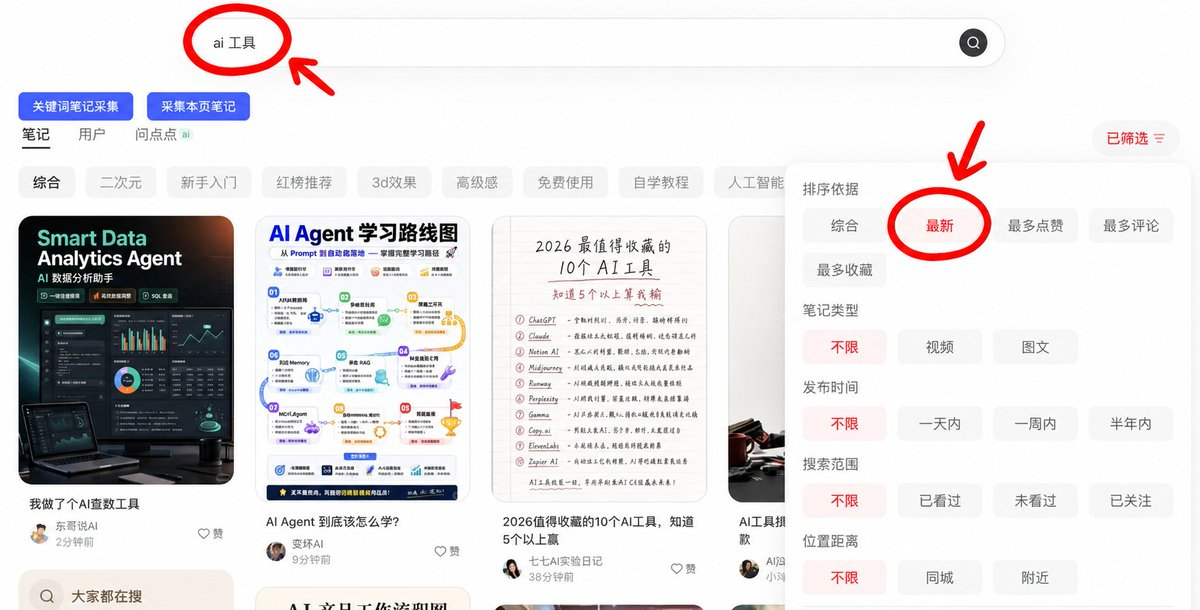
In practice, search for keywords in your vertical niche and switch to “Latest” to find worthwhile recent samples. When analyzing them, follow platform rules and respect others' rights; avoid copying the original text.
Reduce AI-Like Language with Evidence
When asking the Agent to revise a draft, do not just say “make it more conversational.” A more effective approach is to provide concrete evidence, such as personal experience, the situation in which something happened, the process of making mistakes, real dialogue, usage data, and changes before and after taking action. This information helps establish credibility.
Treat the First 10 to 20 Posts as a Validation Period
Do not immediately copy everything because one post performs well, and do not give up too early because three posts in a row perform poorly. A more reliable approach is to define test topics and observation metrics in advance, review the full cycle together, and then decide what to keep, change, or stop in the next round.
Use the Project Documentation to Understand the Skills More Deeply
In addition to the six Skill directories, the repository provides several internal documents. INDEX.md records Skill dependencies and the recommended order, BOOK_OVERVIEW.md provides interpretation and critique of the original methodology, DIGEST.md summarizes its key methods, and verified.md stores verified methodology units. rejected/ records suggestions that were not included in the Skills and the reasons why.
Usage Boundaries and Considerations
- Skills provide content operations methods and decision support; they do not guarantee follower growth, traffic, or monetization results.
- Platform rules, recommendation mechanisms, and tool capabilities may change, so verify them against current rules before publishing.
- Claims such as “warming up an account” or “specific devices get better traffic” lack stable evidence and are not included in the execution workflow.
- When analyzing benchmark content, learn only from its structure, mechanisms, and user needs. Do not copy the original text or infringe on others' rights.
- The project currently plans to add a unified entry Skill, account and scheduling templates, Chinese display names, and automated regression tests. For now, you can still specify modules manually according to the task.
Summary
WorkBuddy XHS Skills turns Xiaohongshu operations from a one-off writing task into a cycle of “positioning, profiling, topic selection, revision, publishing, and review.” The most effective starting point is not asking the Agent to write ten posts immediately, but providing real experience, a target audience, monetization intent, and communication boundaries, then continuously refining the account profile and next experiment with data from the first 10 to 20 posts.