


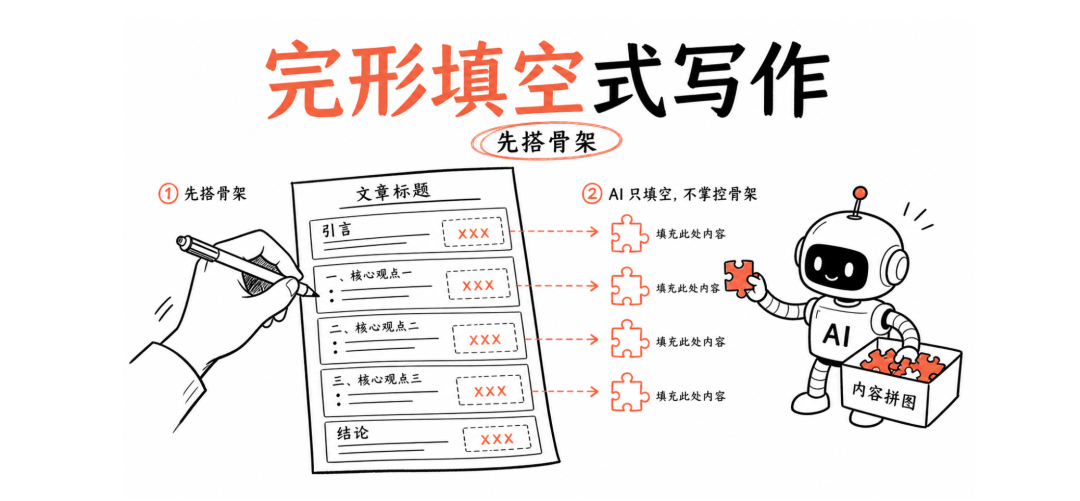
How do you use AI to create something that feels human?
It seems that everyone assumes a good prompt, or a Skill designed to remove the AI feel, is enough. But I think that no matter how powerful the model is, even with a Skill, it cannot produce an article in your own style in one step. I maintain several writing Skills myself, as well as a blacklist of AI-sounding phrases, but those are all final-stage processes. What really works is this: write the outline yourself and let AI optimize it. But the outline should not be written blindly. It should express your writing direction in the shortest time possible. That is what I want to share in this article: the cloze-style writing method.
01 The AI feel is a structural problem in the article If you tell any AI, “Help me write an article about XX,” it will build the entire article from scratch. The framework, paragraph order, and content of each paragraph all come from the model. It does not have your experiences, your judgments, or the pitfalls you have encountered. It can only fill the topic with the safest possible language. At that point, even if you remove the words that sound like AI, the article will still be bland.
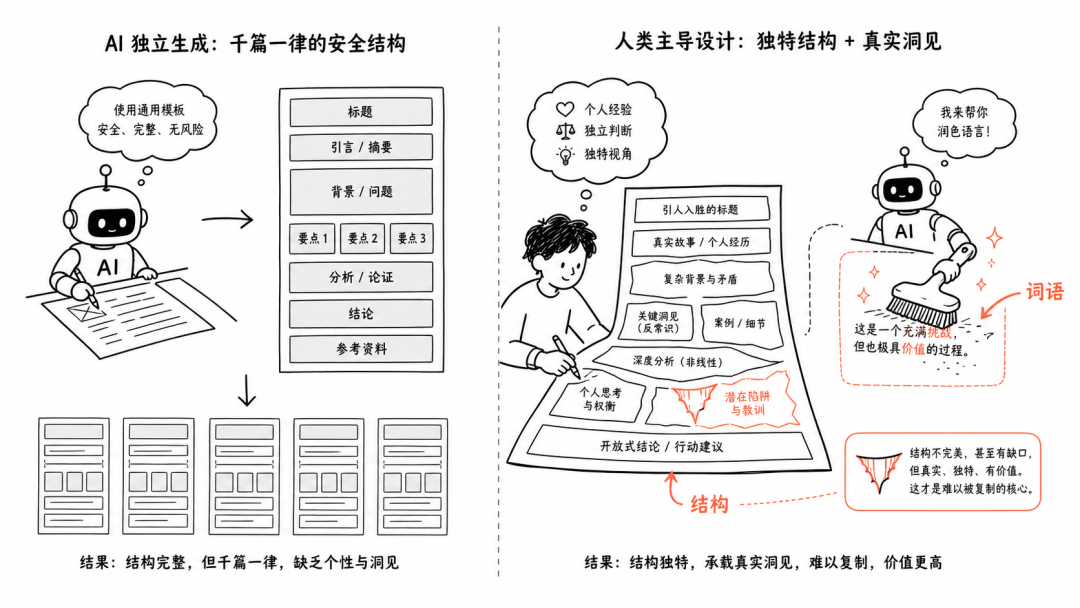
You can remove the AI feel from the wording, but not from the structure. Human-feeling articles are structured by people: What is the theme? What point are you mainly trying to make? How should the different paragraphs develop and transition? Here is the writing method that has worked for me time and again.
02 Cloze-style writing: the faster, the betterBy “cloze-style writing,” I mean writing out the structure of the article you want to write in one go. Whenever you come across a word you do not know, an example you cannot recall, or an explanation where you get stuck, simply type xxx and keep going. For example, I am preparing to publish the article below in a couple of days. It took me less than three minutes to write the outline, and the result was exceptionally good.
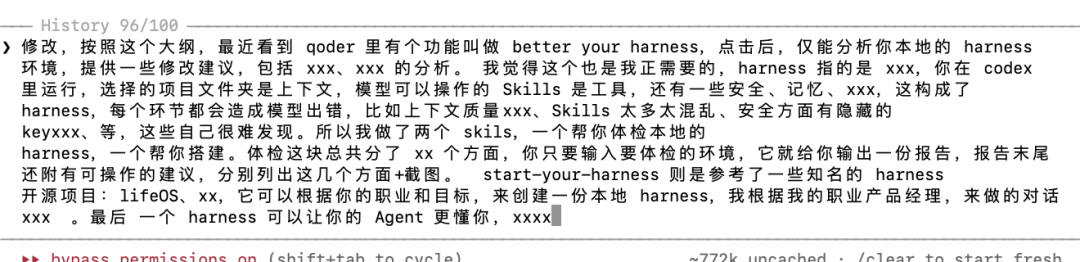
>There is only one key word: speed. Do not stop for ages over a number or a word. Keep your train of thought going; once you stop, it breaks. It does not matter if the sentences are awkward, the punctuation is messy, or there are many typos. Once you finish, you have the skeleton of the article. I have completed the hardest part; the rest can be handed off. AI can fill in the xxx sections:
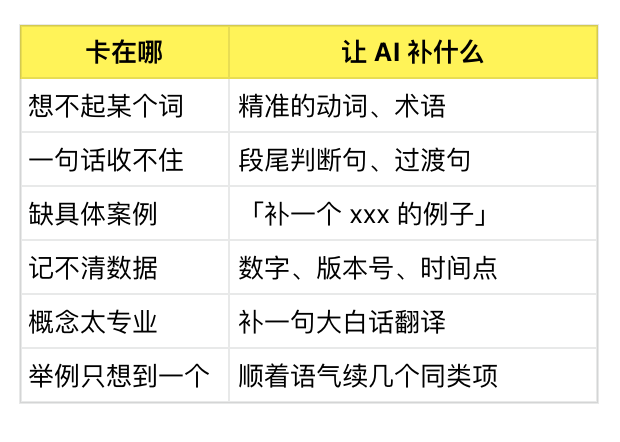
>Add a note in parentheses after xxx to make the result more accurate: I tried many times, but it never worked xxx (add a specific example of a failure, in a conversational tone)Cloze-style writing is the most reliable because it depends on your own expression.
03 Before the outline: topic selection and narrative Topic selection means finding keywords. Codex, starting an account on Xiaohongshu, video production Skills, or a newly emerging trend. The value is not in what you want to write about, but in whether anyone is looking for it. Once you have a topic, consider what you can contribute. This determines the narrative approach:
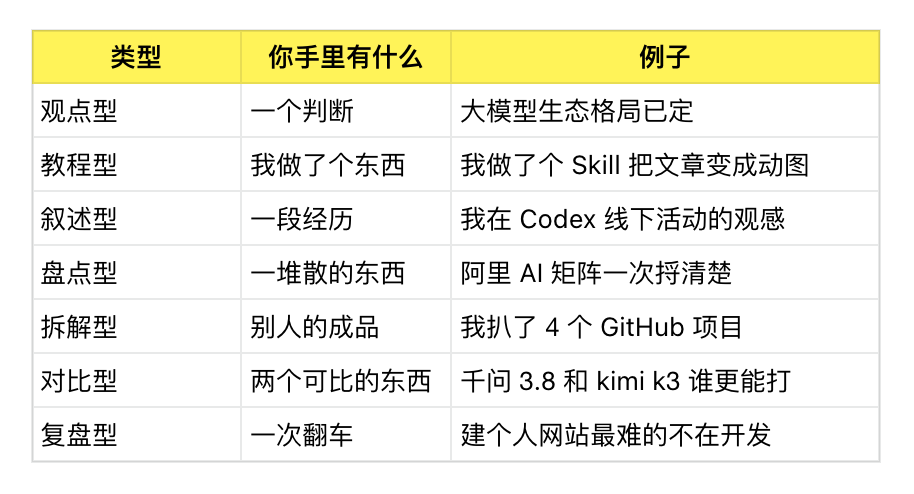
>The same topic can become completely different articles when told through different narratives. Only after deciding this step should you move on to the outline. You can ask AI to produce two or three versions to spark some ideas. But the direction of the actual article is still best developed by typing or speaking in your own words.
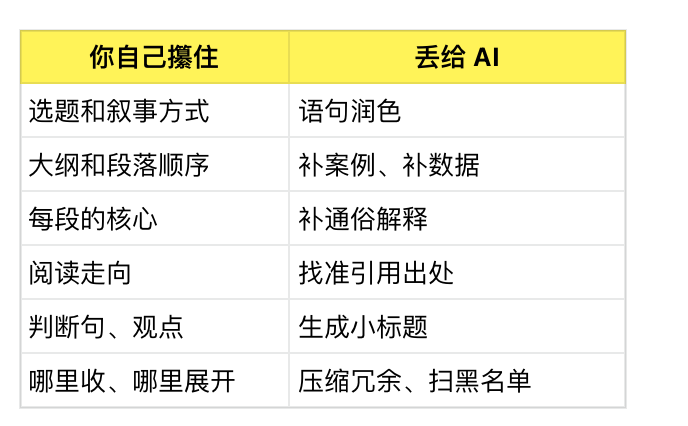
>There is a cloze-style writing Skill at the end of the article.
04 How to maintain a consistent style When it comes to handling writing style, there are two approaches: First, give your previous articles to AI and ask it to extract the style, save the result as a document, and include it every time; second, if you have no existing material, describe it aloud. Record a sample of how you normally talk to friends or how you express yourself in meetings. Your style is in the way you naturally express yourself. There is one more thing you must do: create a blacklist of AI’s high-frequency words.
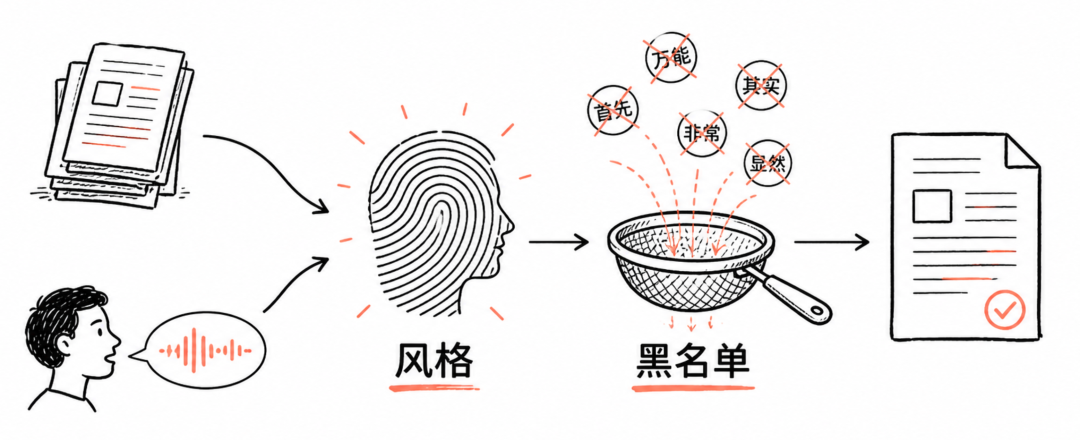
Jargon: empower, close the loop, lever, granularity, moat, mindshare, underlying logic, cognitive upgrade, break through the bottleneck, add support, consolidate
Clichés: as everyone knows, needless to say, it is worth noting that, in conclusion, thus it can be seen that
Era-speak: in today’s digital age, with the advancement of technology, in this era
Sentence patterns: “not … but …,” “from A to B,” long strings of parallel phrases, four-character paired expressions
The last category is the most insidious. Readers cannot say exactly what is wrong, but they can tell it feels fake. Model choice matters too. In my testing, writing ability is roughly Fable 5 > Opus 5 > GPT 5.6 > others (I have not tested the others in depth, so I will not draw a conclusion). Fable’s writing is more relaxed and is suitable for producing the main text; Opus is more reliable for long-form structure.
05 Use logic diagrams for illustrations The biggest mistake with illustrations is finding a pretty image just to fill space. A good illustration should contain information and give readers the feeling of “I get it instantly” at a glance. Three common types are: comparison (how A differs from B), process (the steps involved in something), and matrix (dividing four sections across two dimensions).
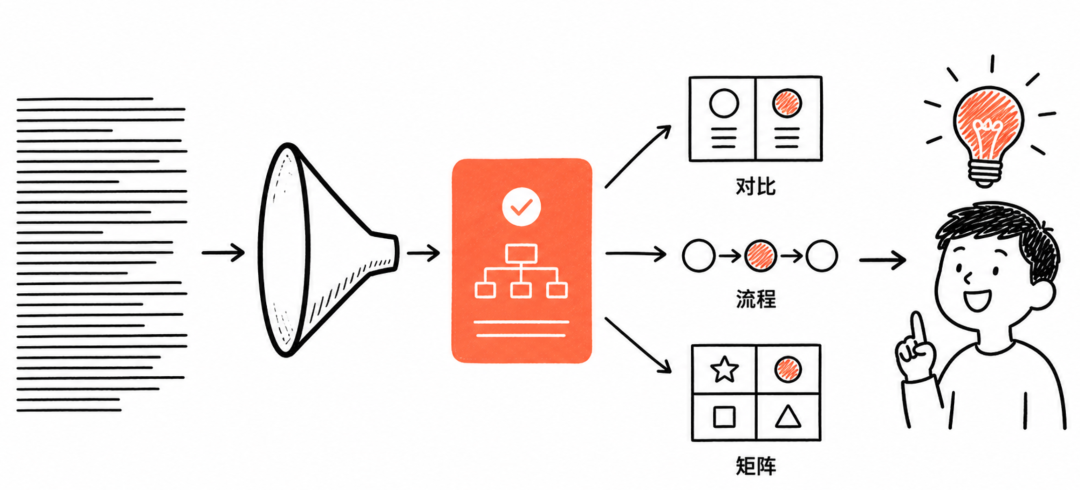
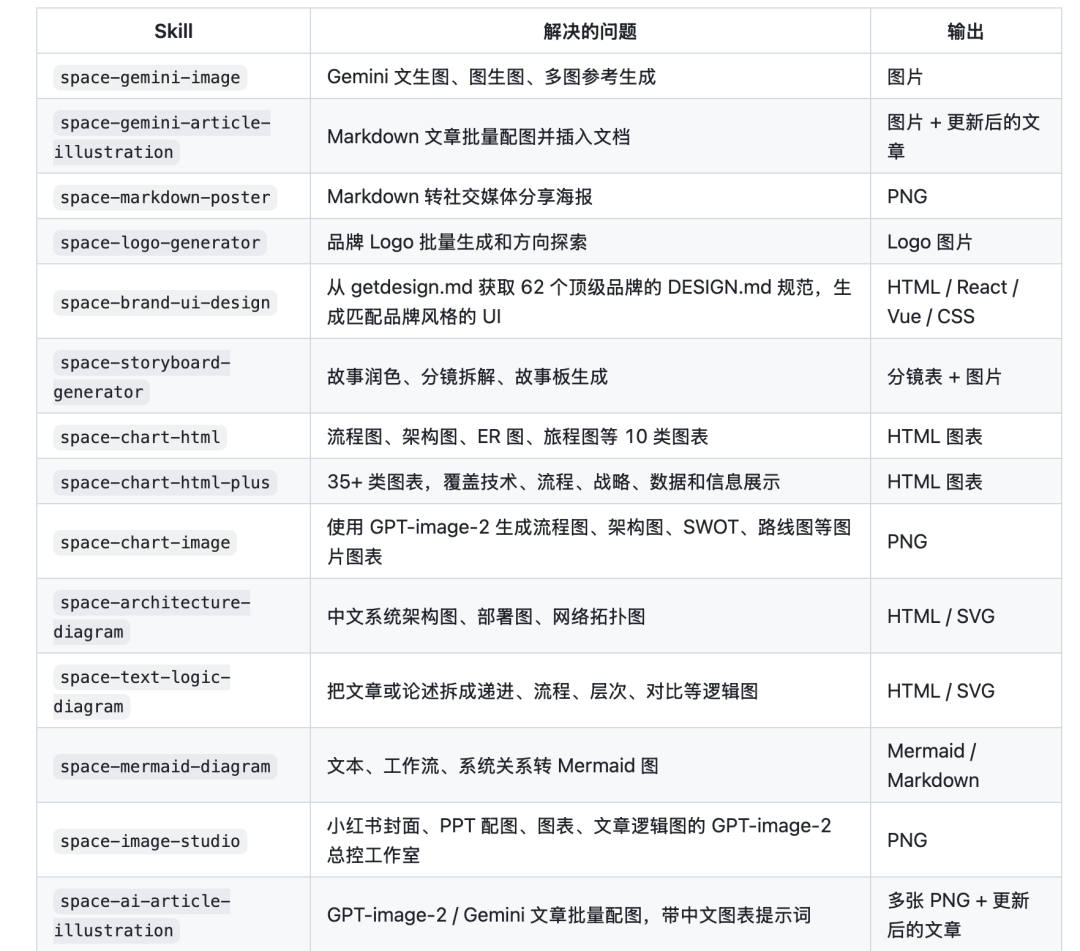
>You can also keep a consistent visual style and add a personal virtual IP as an accent. A good illustration compresses a paragraph into a single image, saving readers the effort of reading. Here is the prompt I commonly use for illustrations. I send the prompt and the full article to NotebookLM and Codex : 1. Image type (based on the article’s content, minimalist design on a white background, design a cover image for each paragraph, simple hand-drawn style, black lines, and a single color as the accent) 2. Image content description (focus on the core idea of each paragraph, use little text, convey the meaning through logic diagrams, with minimal text and an emphasis on logic). I have also gathered methods for creating illustrations with HTML, SVG, and Mermaid here. Repository address: github.com/SpaceZephyr/design-buddy
>06 Context Building context means putting all the articles you have read and written in the same project. Have the Agent extract your writing style, content positioning, and personal introduction. Each time the Agent produces content, it should refer to these materials. Below is my personal writing project. It can be used with any Agent, including obsidian, cursor, Codex, claude, workbuddy, and qoder.
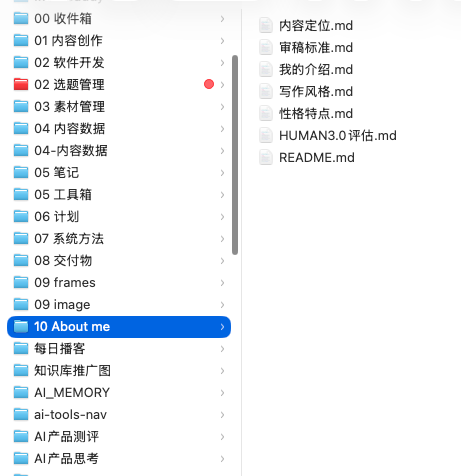
>Any Agent can open these files. There is no one-click solution for removing the AI feel. Prompts and Skills can eliminate words that look obviously fake at a glance, but they cannot fix an article whose structure was decided by AI. There is only one thing you need to do: before AI starts writing, explain in your own words what you want to say in the article. The tool does not matter, the Skill does not matter, and the prompt does not matter. What matters is your data, your ideas, and your expression. Preserve these, and no matter how models and tools develop, you will always have room to put them to use. The methods mentioned above all have corresponding Skills: github.com/SpaceZephyr/creator-buddy