

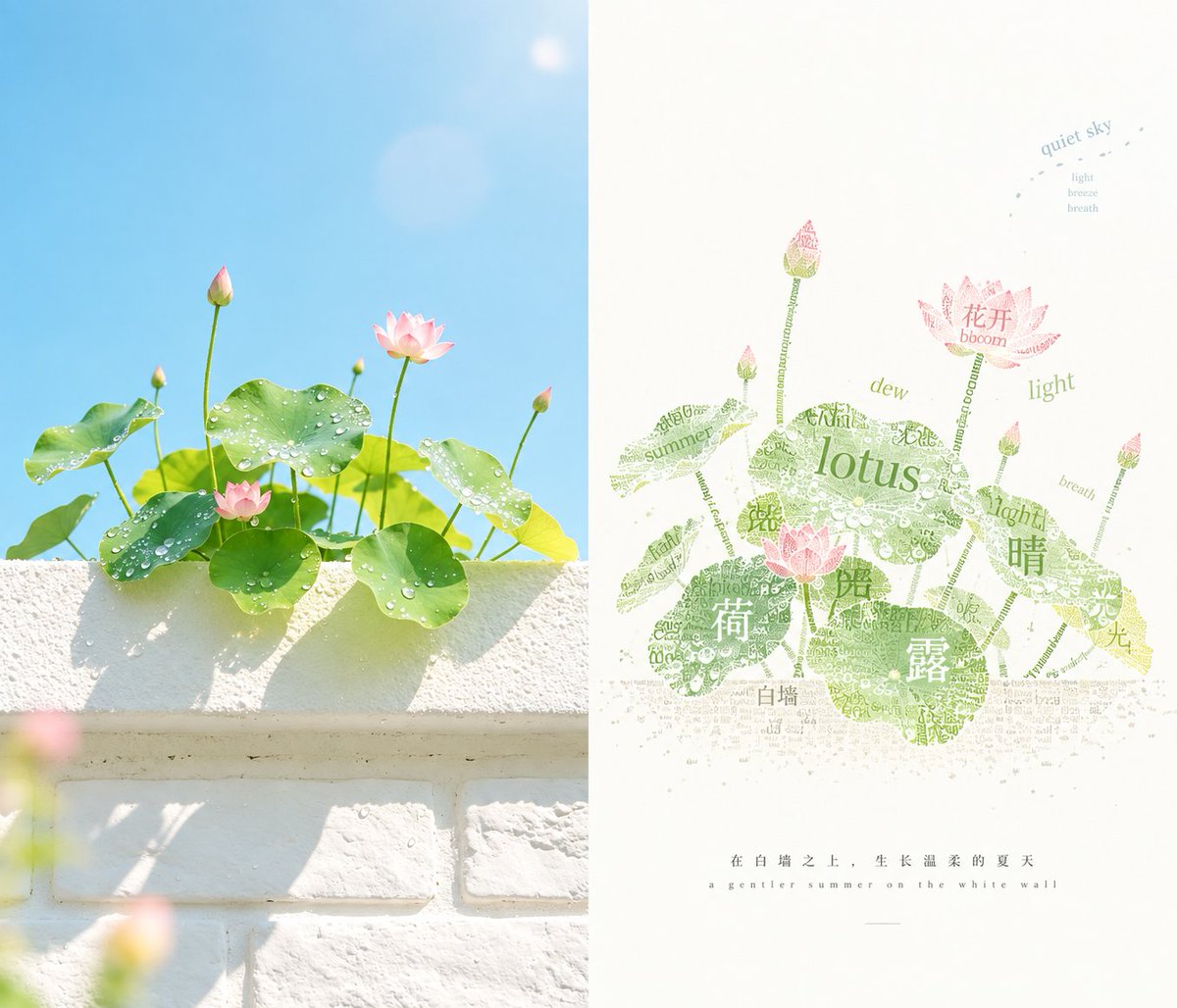
Prompt
Create a separate premium designed poster from each uploaded photo, with no multi-photo collages. Output each photo individually. Use a 3:4 portrait layout divided into two strictly equal-height sections, each occupying 50% of the frame.
Keep the original photo in the upper half, preserving the subject’s identity, structure, pose, realistic texture, natural lighting, and original color atmosphere. Apply only subtle, refined color grading for an art magazine, independent publication, and exhibition-image aesthetic. Extend the environmental background naturally as needed to fit the format, without stretching, distorting, or altering the subject.
In the lower half, extract only the photo’s most recognizable **subject, outline, structure, pose, and narrative relationships**, and reconstruct them as a “**text as image**” typographic illustration. Do not fully copy the photo or retain every object; remove most of the background and irrelevant details, using text as points, lines, planes, and particles. Through **repetition, scaling, rotation, variation in density, path arrangement, and selective overlap**, reshape the subject’s outline, mass, movement, and defining features, so its correspondence with the photo above is immediately recognizable.
The text itself must perform the shaping function, rather than serve as decoration placed over an image. Use larger characters to form the framework and primary contours, dense small text for shadow, texture, and visual weight, and sparse text for edges, air, and a sense of dissolution. In selected areas, text may curve, gather, break apart, or gradually become sparser along the subject’s movement, creating the visual language of **Typographic Illustration / Calligram / Typographic Texture / Visual Poetry**. Derive the text from the photo’s subject, location, mood, action, memory, or metaphor. Choose the language freely according to the visual context, avoiding meaningless gibberish and mechanical repetition.
The lower half must preserve **a large amount of deliberate negative space**. The subject should occupy a small or moderate visual area and may be off-center, pressed against an edge, suspended, or partially cropped. Let negative space and text density participate in the composition, using figure-ground relationships, concentration and dispersion, scale contrast, and asymmetrical balance to create breath and spatial depth. Even when the original has a cluttered background or a very small subject, re-direct the image through reduction, reorganization, cropping, and changes of scale rather than copying the original composition.
Extract **2–4 of the most vibrant and distinctive colors** from the upper photo and remix them, moderately increasing brightness and purity while reducing muddiness, so the text colors feel clear, vivid, warm, and contemporary. Use a large near-white area, or an extremely light base color that echoes the overall color temperature of the original image, as breathing space. Avoid muddy grayness, somber tones, cheap oversaturation, and overly complex multicolor schemes.
The overall result should combine **graphic text, figurative typographic forms, text particles, visual poetry, generous negative space, and sophisticated editorial composition**: from a distance, the viewer first reads a concise, powerful image; only up close do they discover that the entire subject is made of text. Avoid ordinary text layout, text overlaid on the photo, complete scene recreation, realistic depiction, filled backgrounds, gibberish, commercial title templates, and complex decoration.