

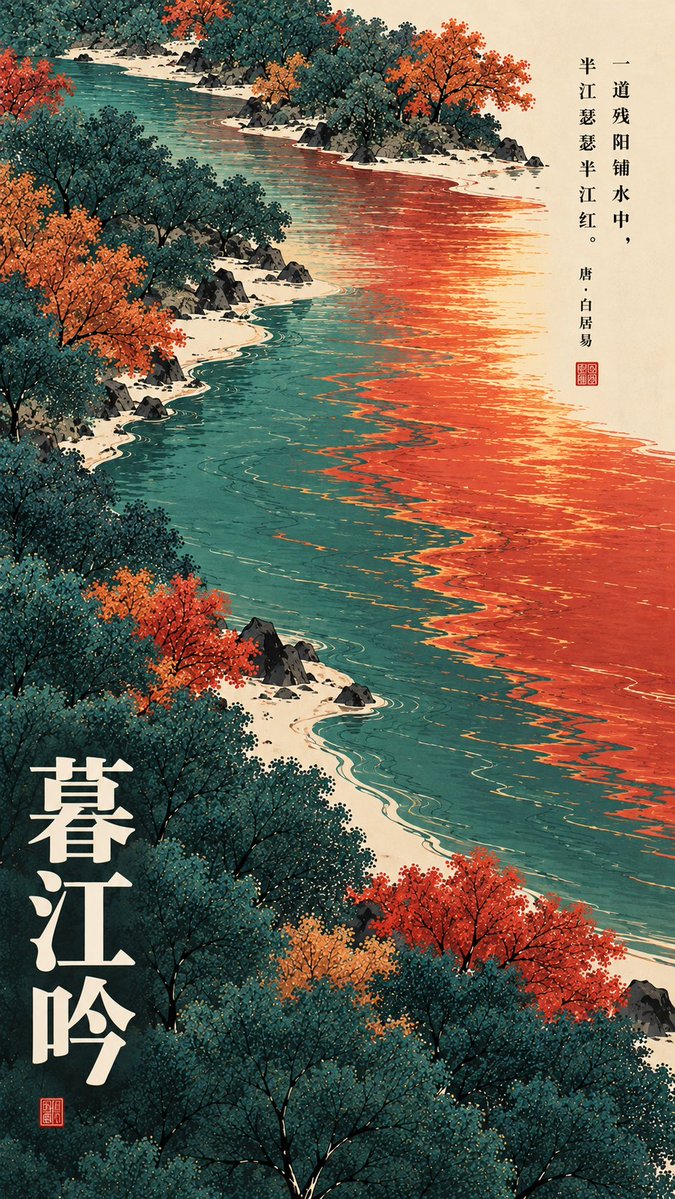
Prompt
[Classical Poetry] {Enter the poem title, author, and original text}
[Main Poster Title] {Extract 2–4 representative Chinese characters}
[Core Imagery] {e.g., two-toned river water, golden rapeseed flowers, orange and green orchards, peach blossoms and ducks}
[Scene] {Enter or have AI derive from the poem}
[Color Palette] {Choose 2–3 harmonious traditional Eastern colors}
[Aspect Ratio] 9:16
Create a new Chinese-style fine-line, colored-art poster with textbook-level illustration quality based on the classical poem. Transform its scenery, colors, and emotions into a complete visual scene rich in Eastern aesthetics.
[Style and Texture]
Use a visual language combining modern Eastern decorative illustration with traditional gongbi fine-line drawing. Render tree canopies as complete, soft, fluffy cloud-like color blocks, with delicately stippled powder texture along the edges and slender, continuous, naturally branching ink-black limbs within.
Simplify plants, flowers, animals, and other scenery moderately according to their real forms, using full, even flat colors and a small amount of refined ink linework. If traditional architecture appears, use orderly blue-green roof tiles, elegant upturned eaves, warm white walls, and vermilion wooden structures. Keep the overall appearance refined, clean, and matte, with a subtle paper texture.
[Composition and Space]
Use a high-angle bird's-eye view, Eastern scattered perspective, and modern planar composition. Organize the image through large color fields, natural curves, partial enclosures, and warm ivory negative space to create a clear visual focus and spatial depth.
Adapt the composition flexibly to the poem, emphasizing its most representative imagery and visual relationships. Render the main subjects in fine detail and simplify supporting elements. Keep the ground and water as clean as possible, using only a few fine lines and irregular ink shadows to suggest space; avoid piling up unrelated elements.
[Eastern Color Palette]
Use traditional Eastern colors such as mineral blue, mineral green, deep blue-green, cinnabar red, ochre red, orange gold, and warm ivory white. Let one dominant color establish visual weight, one contrasting color emphasize the core imagery, and pair them with ink-colored lines and clean negative space.
Keep the colors rich, continuous, and even, with clear warm-cool or value contrast. Preserve broad, uninterrupted color fields; do not use cluttered gradients, heavy textures, or excessive distressed effects.
[Chinese Poster Typography]
In a dark area at the bottom or side of the image, incorporate a large warm ivory Chinese title in a bold, upright, elegant Eastern art typeface.
In suitable negative space, add a small vertical arrangement of the original poem, an accurate author credit, and a few vermilion seals. Keep the text clear and hierarchically organized, with the mature design sensibility of a cultural poster.
[Final Quality]
From a distance, present striking, complete color fields and a graceful composition; up close, reveal exquisite, delicate gongbi linework. Maintain a visual hierarchy of finely rendered architecture, simplified plants, and open background space.
Avoid realistic photography, 3D, anime, thickly painted oil textures, heavy ink wash, dense individual leaves, complex backgrounds, excessive grain, and artificial aging.
The final result should be a poetic, vividly colored, finely crafted new Chinese-style classical-poetry art poster with a cohesive series aesthetic.