

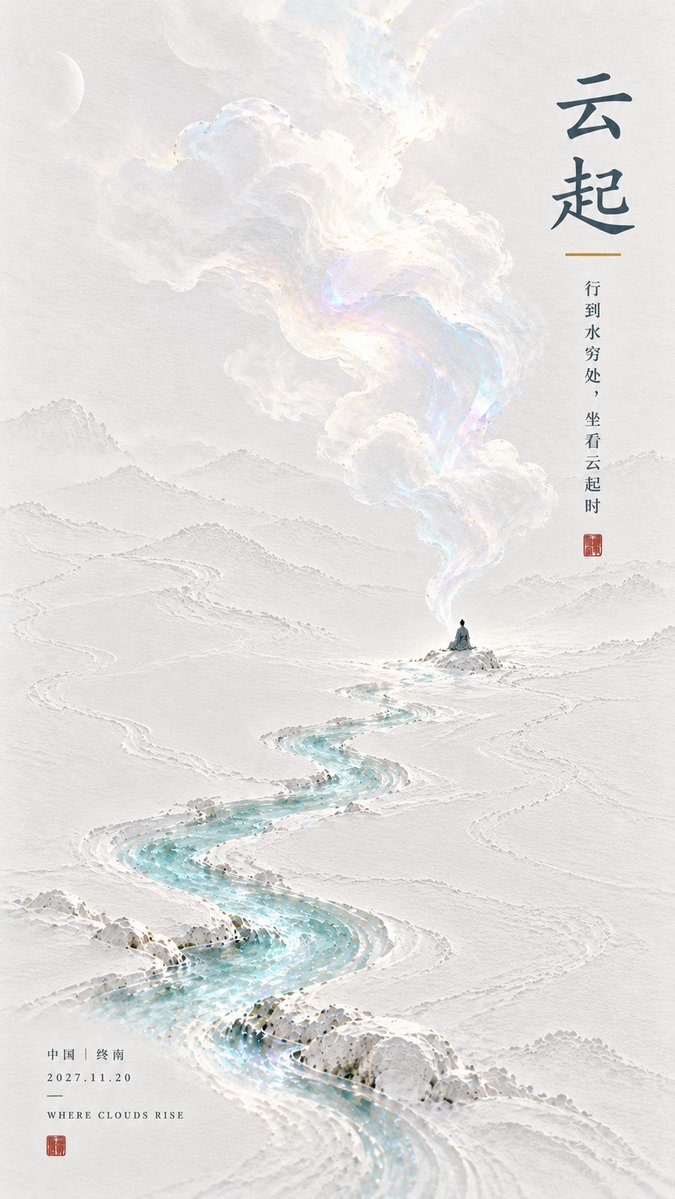
Prompt
Create a 9:16 portrait Oriental poetic negative-space art poster.
Do not depict the 【original poem】 as a complete classical landscape. Instead, extract its most visual 【core mood】 and 【visual action】, and complete the visual translation through one small, clear 【central subject】.
Use near-white premium handmade art paper as the background, retaining fine paper fibers and natural embossing, with approximately 65%–75% effective negative space. Keep the subject relatively small, allowing the blank space itself to express distance, silence, time, and space.
Design a unique visual transformation based on the poem, for example:
light passing through a forest to illuminate only a small patch of moss;
moonlight broken apart by pine needles before falling into a clear spring;
birdsongs transforming into extremely fine lines entering the water;
water becoming light clouds as it reaches its end;
color appearing only when moisture touches clothing or stones;
petals gradually fading from color into shallow white bas-relief.
Add white shallow-relief 【bas-relief content】 related to the theme. These textures should suggest traces that once existed, are disappearing, or have already passed through, rather than serving as mere decoration. Keep the image clean from a distance, with hidden information revealed only up close.
Use 【main color】 in a small, concentrated area. You may add bright colors such as emerald green, ice blue, rouge pink, cinnabar orange, champagne gold, and pearl white, with a subtle glow, but they must follow the material logic of water, jade, petals, clouds, or paper. Avoid neon and cheap special effects.
Choose whether or not to include a person according to the poem. Add a tiny figure when scale is needed; if the verse emphasizes “无人,” “空,” or “静,” leave traces of human presence through a wine glass, doorway, footprints, an old path, or an empty chair.
All water lines, rays of light, clouds, sound lines, and movement trails must be continuous, soft, and natural. Avoid excessive breaks, fragmented lines, and chaotic AI textures.
Use 【two-character theme】 as the main title, paired with a concise verse, 【location】, 【date】, and 【English subtitle】. Use modern Song type, Ming-style type, or an elevated Chinese serif font, maintaining accuracy, clarity, and an editorial feel.
Overall presentation:
Wang Wei’s poetic spirit × expansive Oriental negative space × premium handmade paper × white shallow relief × small subject × subtle glow and color × Editorial Design.
Simple with a clear visual focus at first glance; the poetic transformation becomes clear at second glance; hidden traces of time embedded in the paper emerge only up close.