

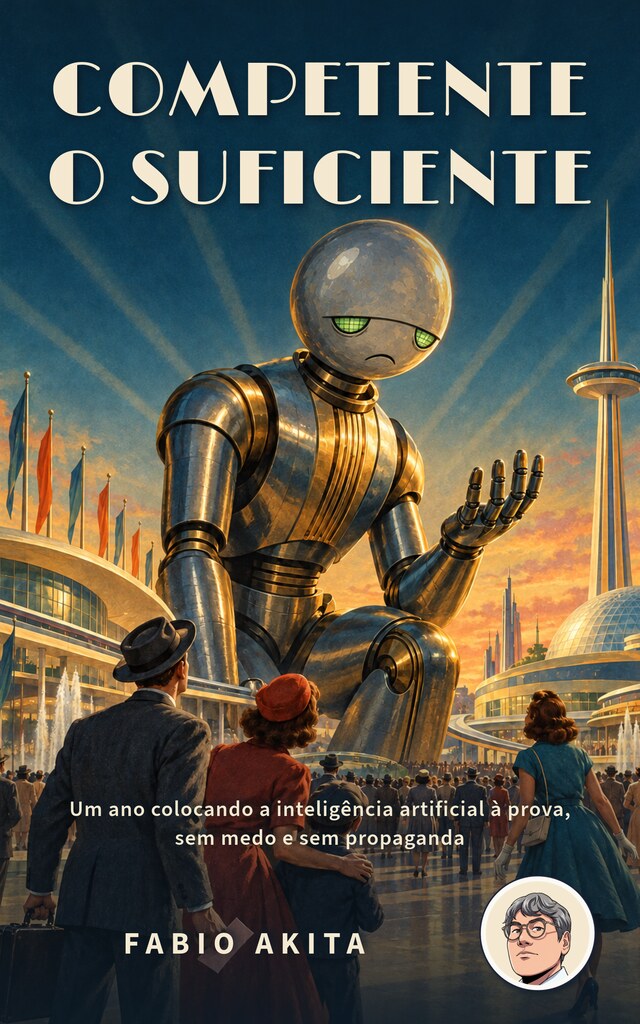
Competent Enough is an open book about artificial intelligence by Fabio Akita. It follows a veteran programmer through 2026 as he builds real software with AI agents, evaluates dozens of models in a personal benchmark, documents mistakes and corrections, and compares industry announcements with evidence.
The repository contains both the book and the tooling used to maintain it. You can read preview editions in Portuguese or English, download finished formats, or build the source yourself with the project’s Ruby- and document-processing workflow.
What the project contains
The book is designed for readers who feel anxious or uncertain about AI, including professionals concerned about replacement, parents following predictions about artificial general intelligence, and managers hearing proposals for an “AI transformation.” Its approach is practical and evidence-driven rather than promotional.
The material is divided into five main parts:
- Part I: What is this thing, anyway? It examines whether AI is intelligent and whether AGI is approaching.
- Part II: The marathon. It asks whether AI works beyond impressive demonstrations.
- Part III: Numbers and propaganda. It explores model comparisons and how to assess announcements.
- Part IV: Who holds the keys? It considers the risks of allowing AI systems to access personal or operational resources.
- Part V: What about my job? It addresses employment concerns and possible next steps.
The repository also includes two interludes, an optional no-math appendix explaining how the machine works internally, a timeline, practical checklists, a glossary containing 144 terms, and 292 references.
Download and read the book
The simplest way to use the project is to download a release. Open the Releases page and choose the latest edition.
- Choose the Portuguese or English edition.
- Select a format appropriate for your device.
- Download the file from the release assets.
- Open it with your e-reader, PDF viewer, or preferred reading application.
The available formats include Competente-o-Suficiente.epub for e-readers, Competente-o-Suficiente-ebook.pdf for screen reading, and Competente-o-Suficiente.pdf for printing. The English edition uses corresponding names such as Competent-Enough.epub, Competent-Enough-ebook.pdf, and Competent-Enough.pdf.
These are preview editions. The book remains open to revisions, and new versions are expected until the author declares the work final.
Set up the build environment
If you want to build the book from its source, clone the repository and inspect the project files, including docs/DESIGN.md and LICENSE.md. The README identifies the required system dependencies as Ruby, Java, and poppler-utils.
Ruby runs the project tasks. Java is required by epubcheck, which validates EPUB output. The Poppler utilities support document-related processing during the build.
After installing these dependencies, use the repository’s task runner to fetch its pinned toolchain:
rake toolsThis task prepares the documented toolchain, including Quarto with Pandoc and Typst, as well as epubcheck.
Build the publication formats
Once the tools and system dependencies are available, run:
rake buildThe build produces EPUB, PDF, web, and DOCX editions under build/pt/. It also runs EPUB validation and a page audit, helping detect problems in the generated output.
A typical workflow is:
- Install Ruby, Java, and
poppler-utils. - Run
rake toolsto fetch the pinned project toolchain. - Update or inspect the source content.
- Run
rake build. - Review the files generated in
build/pt/and address any validation or page-audit issues.
The README does not describe a separate English output directory, so follow the repository’s current documentation and task configuration when working with the English source.
Track changes from the blog
The repository is designed to stay synchronized with the author’s articles on akitaonrails.com. Each paragraph records which article it came from. This makes it possible to identify book content that may need review when an article changes.
Run the drift check with:
rake drift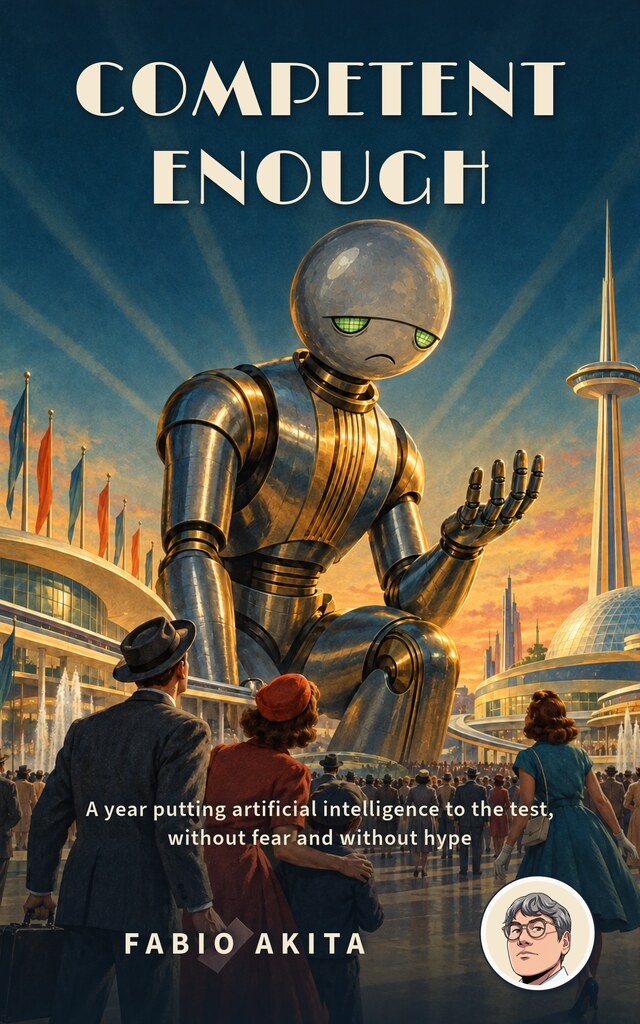
The command reports which chapters are affected by changes in the blog and shows the relevant diff. Use it before a release or after updating source articles to understand what needs to be revised.
Understand the project’s production approach
The repository treats the book as a maintained publication rather than a static document. Diagrams are drawn as code, AI-generated illustrations are disclosed in image credits, and real photographs include their licences. More detail about this process is available in docs/DESIGN.md.
This approach is useful when reviewing or contributing to the project because it separates text provenance, generated assets, and licensing information. Before redistributing a build, read LICENSE.md carefully.
Advanced tips for working with the repository
Use releases for reading and the source for maintenance
Readers generally should use the release assets because they are already packaged for common formats. Use the source repository when you need to inspect the book’s construction, reproduce a build, or investigate changes between the blog and the book.
Run drift checks before publishing
If article content has changed, run rake drift before rake build. This gives you a focused list of potentially outdated chapters and helps keep the generated editions aligned with the underlying articles.
Keep validation in the build loop
The build task includes epubcheck and a page audit. Treat those checks as part of the publication process rather than optional extras, especially when changing templates, diagrams, or document structure.
Review licensing before reuse
The book’s text, cover, and illustrations are copyrighted by Fabio Akita, while the build scripts and templates are MIT-licensed. Fonts, citation styles, and photographs may have separate licences listed in LICENSE.md. Do not assume that every file in the repository has the same reuse terms.
Conclusion
Competent Enough combines a critical AI book with a reproducible publishing workflow. You can download a preview edition from Releases, build the available formats with rake build, and use rake drift to identify content affected by changes to the source articles. The result is a practical way to study AI claims while also exploring how a long-form technical publication is maintained.