

- Monthly visits
- 0
- Pricing
- Free
- Listed
- 2025-09-03
- Updated
- 2026-08-25
01Product Positioning
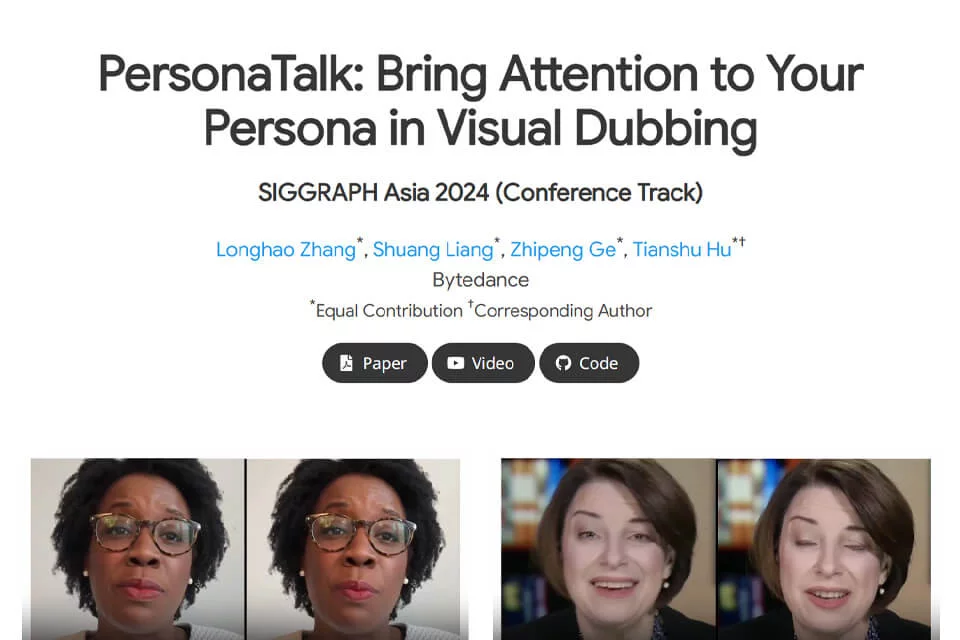
PersonaTalk is positioned as an AI visual dubbing framework focused on solving the mismatch between a person's lip movements and voice after dubbing is replaced. It takes footage of a person and target audio as inputs, generates a version in which the lips follow the new audio, and preserves the person's original facial performance and visual style.
The framework is intended for content production workflows involving people speaking on camera, and is suitable for tasks such as language replacement, character dubbing, and facial animation generation.
02Key Features
The tool matches target audio to a person's lip movements in video while attempting to preserve the person's distinctive speaking style and facial performance. Its dual-attention facial rendering mechanism focuses separately on the lip region and other facial regions, helping retain details such as skin texture and makeup while reducing visual issues such as teeth flicker.
PersonaTalk processes new people in a zero-shot manner; the available materials indicate that separate training or fine-tuning for each new person is not required.
03Use Cases
Film and television localization teams can use it to create dubbed footage in different languages, with the person's lip movements adapting to the target language. Advertising teams can adapt the same video for language versions in different regions while preserving the person's performance in the original footage.
Online education content can use it for course language conversion or virtual instructor video production. Animators and digital human developers can use it to generate character lip movements and facial expressions, especially for footage featuring people speaking toward the camera.
04Usage Considerations
Before use, prepare footage of a person and target audio. The final result depends on whether the input materials are suitable for facial and lip processing. For clips with occlusions, complex facial movement, or unclear audio-visual alignment, inspect the output segment by segment to verify that the lip movements, teeth, and facial textures look natural.
The available materials currently do not provide deployment steps, hardware requirements, processing speed, output formats, or the boundaries of use in complex scenes. Before adoption, consult the project documentation and test representative materials.
© Disclaimer: domains and linked content may change over time. AIEZZ does not control third-party websites. Review external content and risks independently.
User reviews0