

- Monthly visits
- 0
- Pricing
- Free & Paid
- Listed
- 2025-09-01
- Updated
- 2026-08-25
01Product Positioning
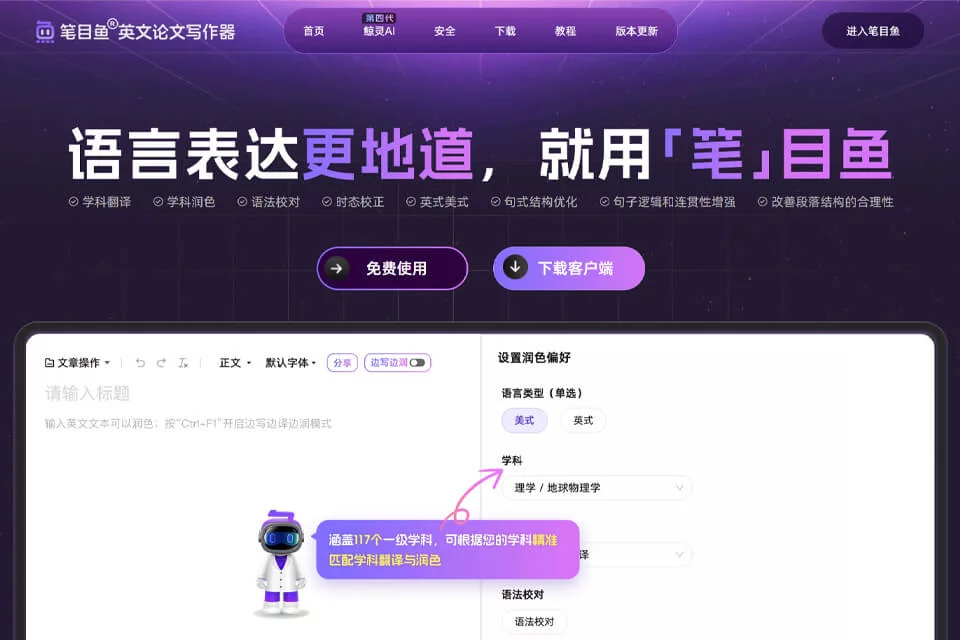
Bimuyu is designed for academic English writing, focusing on translation, wording, and language polishing when converting ideas in Chinese into English academic writing. Built around the research writing workflow, it supports continuous operations from entering a Chinese draft and converting it into English to receiving sentence revision suggestions.
It is especially suitable for Chinese researchers who need to work with English papers, including master's and doctoral students, university teachers, medical and STEM researchers, and users with limited experience in English academic writing.
02Key Features
The product provides subject-specific English translation and polishing, with a three-panel linked interface that simultaneously displays the Chinese input, English translation, and polishing suggestions. According to the available materials, Bimuyu covers 117 specialized disciplines and provides an SCI example sentence library for reference when users need professional expressions and sentence structures.
For literature assistance, Bimuyu supports recommending literature by paper topic, reading literature, inserting citations, and generating reviews. It also provides rewriting, expansion, condensation, and AIGC detection.
03Use Cases
Bimuyu can be used for drafting English papers, translating Chinese research ideas, polishing paragraph language, referencing professional sentence structures, and organizing literature. Research scenarios in medicine, biology, chemistry, STEM, and other fields that involve technical terminology can use it as an aid for English expression.
For users preparing graduation theses, submitting to English-language journals, or conducting routine research writing, it is suitable for handling language-level organization and helping users view translations and revision suggestions within the same writing workflow.
04Usage Notes
AI-generated translations and polishing suggestions may be affected by context, technical terminology, and the research field. Users should review key concepts, data descriptions, method names, and conclusions sentence by sentence, and revise them according to the target journal's formatting and language requirements.
Literature recommendations, citation insertion, and review generation also require manual confirmation of source relevance and citation accuracy. AIGC detection and text-reduction results should not be regarded as guarantees of submission outcomes. The author remains responsible for the academic content, citations, and expression in the final manuscript.
© Disclaimer: domains and linked content may change over time. AIEZZ does not control third-party websites. Review external content and risks independently.
User reviews0