
- Monthly visits
- 0
- Pricing
- Not set
- Listed
- —
- Updated
- 2026-11-06
01What is Ling-3.2-flash?
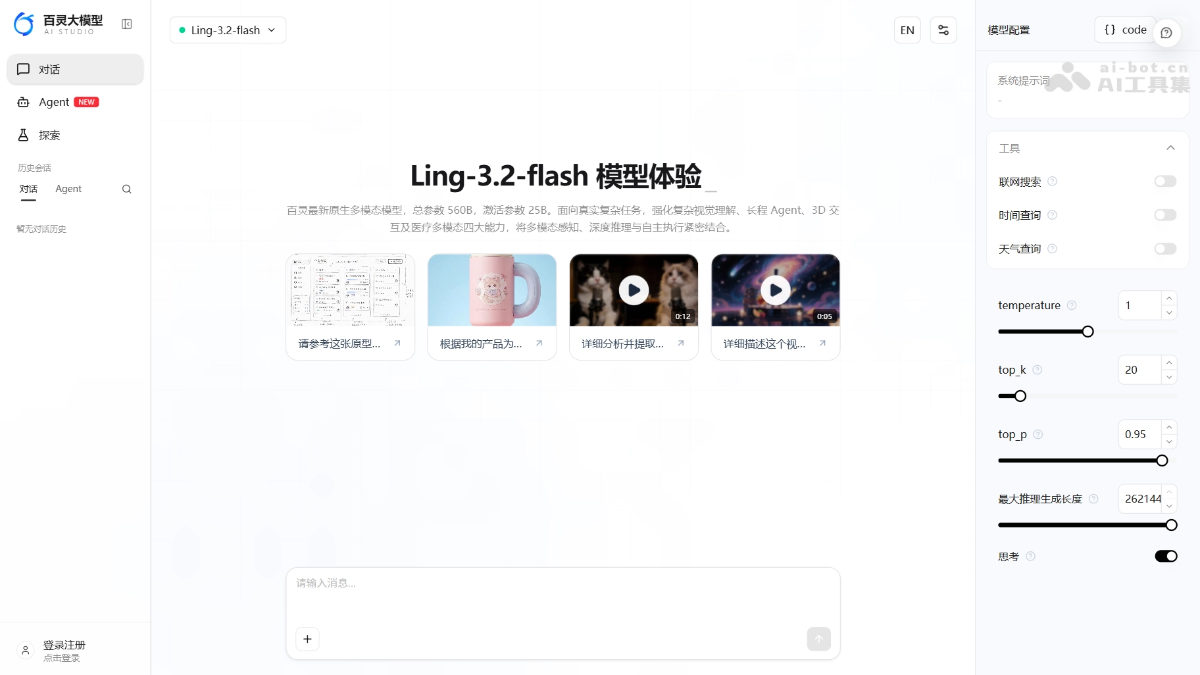
Ling-3.2-flash is the latest native multimodal large model launched by Ant Ling. It uses a Mixture-of-Experts (MoE) architecture with 560B total parameters and activates only about 25B per step. Its context window reaches 1M, with native support for image, text, and video inputs. The model focuses on four capabilities: complex visual understanding, multimodal long-horizon Agents, 3D understanding and interaction, and medical multimodality. According to official self-evaluations, it surpasses Claude Opus 5 on three benchmarks.
02Key Features of Ling-3.2-flash
Complex visual understanding: Deeply understands image and video content to support visual reasoning and analysis tasks.
Multimodal long-horizon Agent: Maintains consistent goals across multistep tasks and makes decisions and executes actions based on visual and textual information.
3D understanding and interaction: Parses three-dimensional scenes and spatial relationships to support 3D-related interactive tasks.
Medical multimodality: Covers medical image understanding and report interpretation to assist professional medical analysis.
1M context processing: Supports long-document and long-video analysis for long-context use cases.
03How Ling-3.2-flash Works
Mixture-of-Experts architecture: Ling-3.2-flash uses a Mixture-of-Experts architecture with 560B total parameters and activates only about 25B per step. Each token is routed only to the most relevant expert subnetworks, retaining high-capacity knowledge storage while reducing per-step computation to a very small proportion. This is the core mechanism that balances model capability and inference cost.
Native multimodal fusion: Unlike solutions that attach an external vision module, this model natively integrates visual and language capabilities at the architectural level. It treats images, text, and video as fundamental inputs for reasoning, enabling deeper cross-modal understanding and distinguishing it from shallow multimodality based on simply “describing images.”
Long-context modeling: The model has a 1M context window and builds on KDA introduced in the Ling 3.0 series to enhance memory updates and information retention across long sequences. This allows target information to be reliably recalled whether it appears at the beginning, middle, or end of the context, with no obvious degradation over long-range information.
Perception-reasoning-execution loop: The model tightly integrates multimodal perception, deep reasoning, and autonomous execution. It continues the “observe → act → verify → correct” visual feedback loop of Ling-3.0-flash-VL, enabling continuous path correction based on intermediate results when carrying out multistep tasks.
04How to Use Ling-3.2-flash
Access the platform: Visit the Ant Ling official website and open the Ling-3.2-flash chat page to try it online.
Obtain a key: Create an API key in the platform console to use as the authentication credential.
Make a call: Send your first request through the API. The model is compatible with the OpenAI and Anthropic protocols, so it can be integrated into existing code in a familiar way.
Take advantage of the free period: The model is free for a limited time during the first two weeks after launch, allowing you to test it thoroughly before evaluating paid usage.
Explore advanced capabilities: Try advanced features such as the 1M long context, image/video inputs, and multimodal Agent tasks.
05Core Advantages of Ling-3.2-flash
Native multimodal understanding: Natively integrates visual and language capabilities at the architectural level without relying on an external vision module.
Four core capabilities: Focuses on complex visual understanding, multimodal long-horizon Agents, 3D understanding and interaction, and medical multimodality, tightly integrating perception, reasoning, and execution.
Balance of capacity and cost: Retains the capacity of a 560B model while limiting per-step activation to about 25B, balancing capability and inference efficiency.
1M context window: Supports long-document and long-video analysis for long-context use cases.
06Ling-3.2-flash Project URL
Official project website: https://developer.ant-ling.com/zh-CN/docs/models/ling/#ling-32-flash
07Ling-3.2-flash Use Cases
Complex visual understanding: Ling-3.2-flash can deeply understand image and video content, supporting visual reasoning and analysis tasks.
Multimodal long-horizon Agent: The model can maintain consistent goals across multistep tasks and make decisions and execute actions based on visual and textual information.
3D understanding and interaction: The model can understand three-dimensional scenes and spatial relationships, supporting various 3D-related interactive tasks.
Medical multimodality: The model can understand medical images and interpret reports, assisting doctors with professional medical analysis.
Long-document and long-video analysis: With its 1M context window, the model can process extremely long documents and videos to meet the needs of long-context use cases.
© Disclaimer: domains and linked content may change over time. AIEZZ does not control third-party websites. Review external content and risks independently.
User reviews0