

- Monthly visits
- 0
- Pricing
- Free & Paid
- Listed
- 2026-01-05
- Updated
- 2026-08-25
01Product Positioning
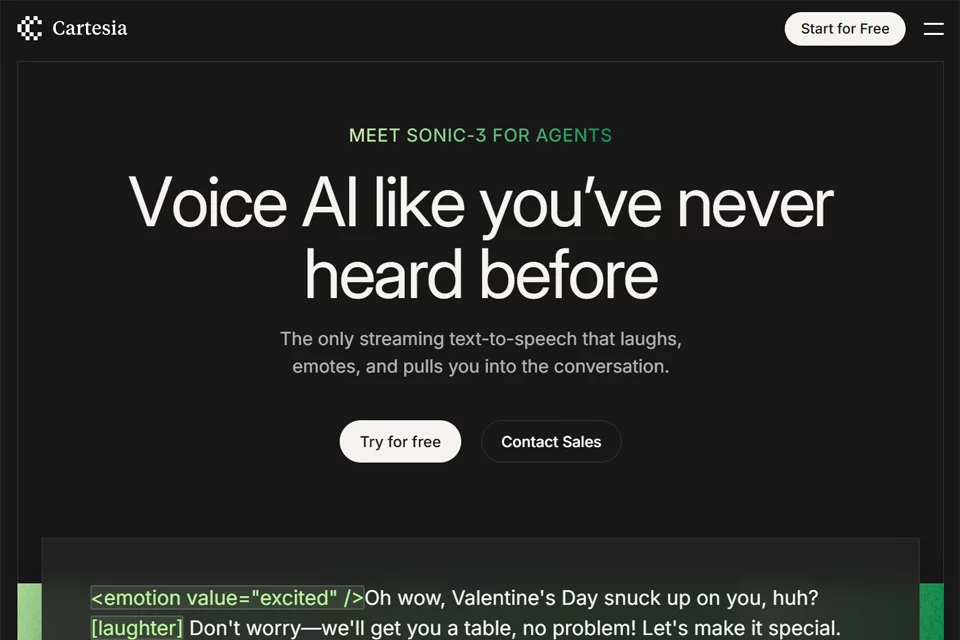
Cartesia AI is a real-time expressive speech synthesis tool focused on interactive products that require immediate voice feedback. Its core Sonic-3 model can generate speech with breathiness, emotional variation, natural laughter, and other expressive qualities. It is designed not merely for text reading, but for voice output that feels more conversational.
The product is aimed at agent developers, enterprise application teams, and game and entertainment content creators. It is suitable for converting text responses into speech that can be played directly or integrated into business workflows.
02Key Features
The platform converts text to speech and provides multilingual generation, with materials indicating native support for more than 42 languages. Voice output can include elements such as laughter, sighs, and emotional variation, making it suitable for dialogue that requires strong expressiveness.
Cartesia AI also provides voice cloning, allowing users to create a voice from a relatively short audio sample and choose between options such as instant cloning and professional-grade fine-tuning. Developers can try and debug the service in the Playground before integrating it into their products through the API or SDK.
03Use Cases
In agents and customer service centers, Cartesia AI can generate real-time voice replies, appointment scheduling interactions, consultations, and similar content. Its low latency is suitable for applications that require continuous dialogue and immediate feedback.
Game, virtual character, and entertainment production teams can use its expressive voice capabilities for character dubbing. International businesses can extend content generation or interactions across multiple languages, while educational and medical institutions can evaluate it for guidance, explanations, and other scenarios requiring a friendly tone.
04Usage Considerations
When using the service, voice performance should be tested against the target language, text content, and emotional requirements. Pay particular attention to the pronunciation stability of proper nouns, abbreviations, accents, and long-form text. Voice cloning results are also affected by the quality and content of the input audio, so the final outcome should not be judged solely by sample length.
For real-time calls or online agents, latency, phrasing, and playback transitions should be validated under real network conditions and within actual business workflows. Before production integration, also confirm the authorization and compliance requirements for the voice samples, generated content, and specific use cases.
© Disclaimer: domains and linked content may change over time. AIEZZ does not control third-party websites. Review external content and risks independently.
User reviews0