

- Monthly visits
- 0
- Pricing
- Free & Paid
- Listed
- 2025-09-03
- Updated
- 2026-08-25
01Product Positioning
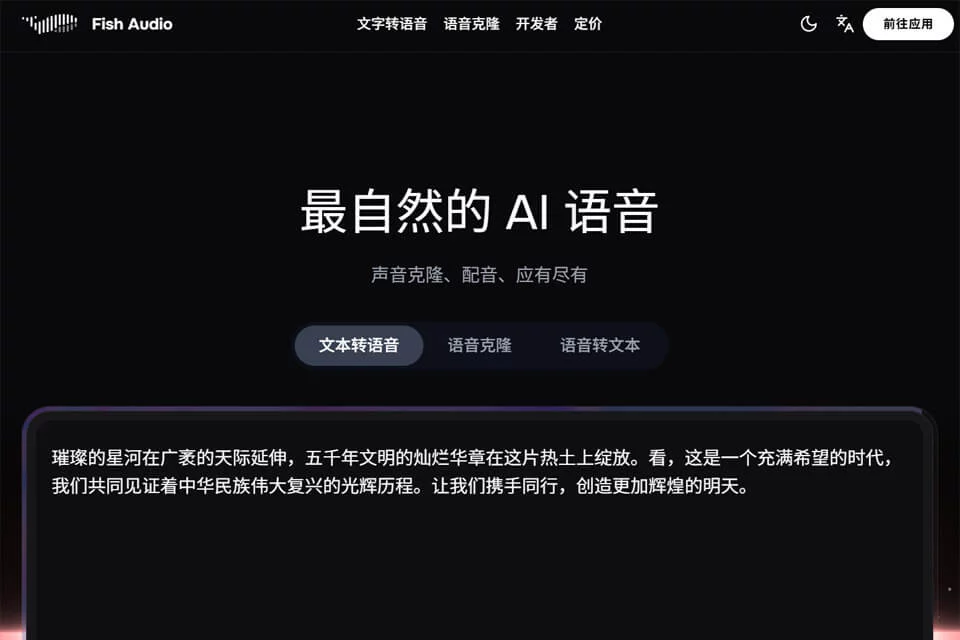
Fish Audio is positioned as an AI voice platform whose core functions are converting text into speech and creating digital voice models from audio samples. It serves content creators, businesses, developers, and educators, covering needs ranging from one-off voiceovers to integrated voice features.
The platform offers free and paid plans. Actual quotas and available features should be verified on the service page.
02Key Features
The platform supports multilingual text-to-speech for generating voice content in languages such as Chinese, English, Japanese, Korean, French, and German. Users can clone a voice from a short audio sample and try to preserve its original timbre, pitch, and speaking style.
For generation control, the platform supports using prompts to adjust emotion, speaking rate, pitch, and volume. Developers can also integrate applications through the real-time speech synthesis API, with streaming output and multiple audio formats. The community voice library offers many voice models to choose from; users should review the permitted usage for each one.
03Use Cases
Content creators can turn scripts into video narration, podcast segments, advertising voiceovers, or audiobooks, and can also use their own voice samples to produce a consistent series of content.
Businesses and developers can integrate speech synthesis into products such as customer service systems, applications, or games. Educators can convert course materials into audio or create listening content for language instruction. For applications that require real-time feedback, the real-time speech synthesis API is better suited to programmatic calls.
04Usage Considerations
Clear, usable audio samples are required before cloning a voice. Sample length, recording quality, background noise, and text content all affect the final result; a short sample does not guarantee consistent performance in every scenario.
When generated speech is intended for public release, commercial content, or use involving someone else’s voice, users should first confirm the voice source and authorization scope, and check the specific usage conditions for community voice models. For content with strict requirements for tone, emotion, or proper nouns, manual listening and proofreading are recommended before publication.
© Disclaimer: domains and linked content may change over time. AIEZZ does not control third-party websites. Review external content and risks independently.
User reviews0