

- Monthly visits
- 0
- Pricing
- Free & Paid
- Listed
- 2026-05-21
- Updated
- 2026-08-25
01Product Positioning
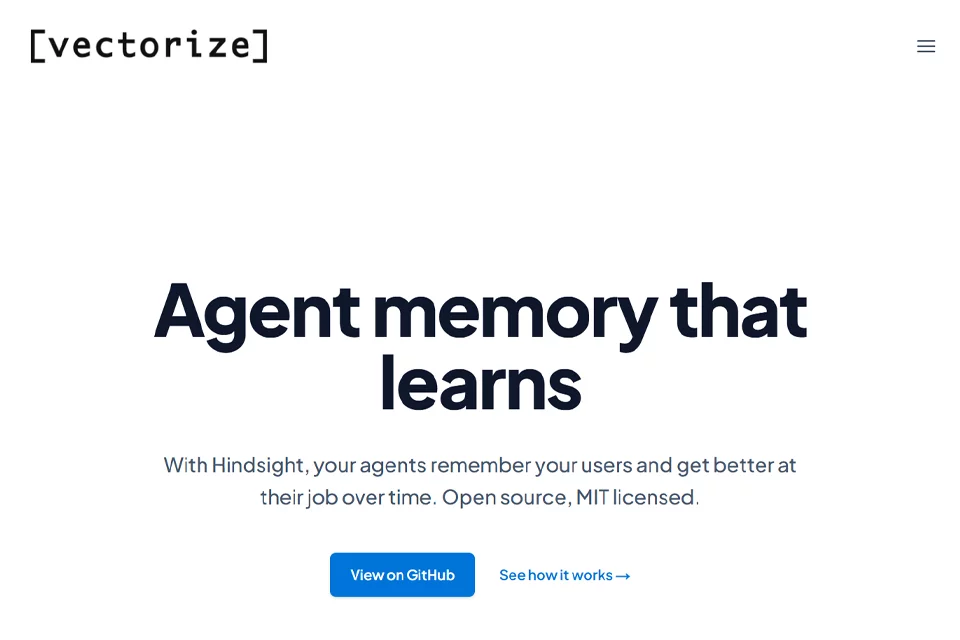
Vectorize is designed for AI agents that need long-term context, focusing on cross-session memory, continuity of user preferences, and accumulated interaction experience. It stores more than searchable information: it also organizes failed calls, user corrections, and recurring scenarios into experience that agents can reference in later tasks.
The product can serve as the memory layer for existing AI applications and is suitable for customer service, internal assistants, personalized applications, and multi-turn collaboration systems.
02Key Features
Vectorize supports persistent user memory, retaining relatively independent context for different users, including preferences, past interactions, and decision information. In later tasks, the system can recall memories relevant to the current request, reducing the need to repeatedly pass along the full background.
It also provides an experience reflection mechanism for consolidating failed calls and user corrections. Integration methods include MCP, REST API, and the Python SDK. Deployment options include the MIT-licensed open-source Hindsight self-hosted solution and a usage-based cloud service.
03Use Cases
AI application developers can add long-term memory to agents, copilots, or chat applications, reducing repeated questions and context assembly in continuous tasks. Enterprise technology teams can use it for customer service, sales support, and internal knowledge assistants while retaining users' interaction history and preferences.
Teams that need to integrate with an existing Agent development environment can use MCP, REST API, or the Python SDK. Open-source projects that want to deploy, audit, or customize their own memory layer can evaluate the Hindsight self-hosted solution.
04Considerations
Vectorize must be integrated with a specific Agent workflow. Before using it, teams should determine which user information, task records, and feedback are appropriate to write to memory and when they should be recalled. The way memories are organized also affects how effectively they can be used as subsequent context, so the application should provide a corresponding data workflow.
The self-hosted solution requires teams to prepare their own infrastructure and manage deployment and maintenance. Cloud and self-hosted services differ in management methods and operational responsibilities. Applications involving user preferences or interaction history should also plan their data management processes according to their own business requirements.
© Disclaimer: domains and linked content may change over time. AIEZZ does not control third-party websites. Review external content and risks independently.
User reviews0