

- Monthly visits
- 0
- Pricing
- Free
- Listed
- 2025-09-03
- Updated
- 2026-08-25
01Product Positioning
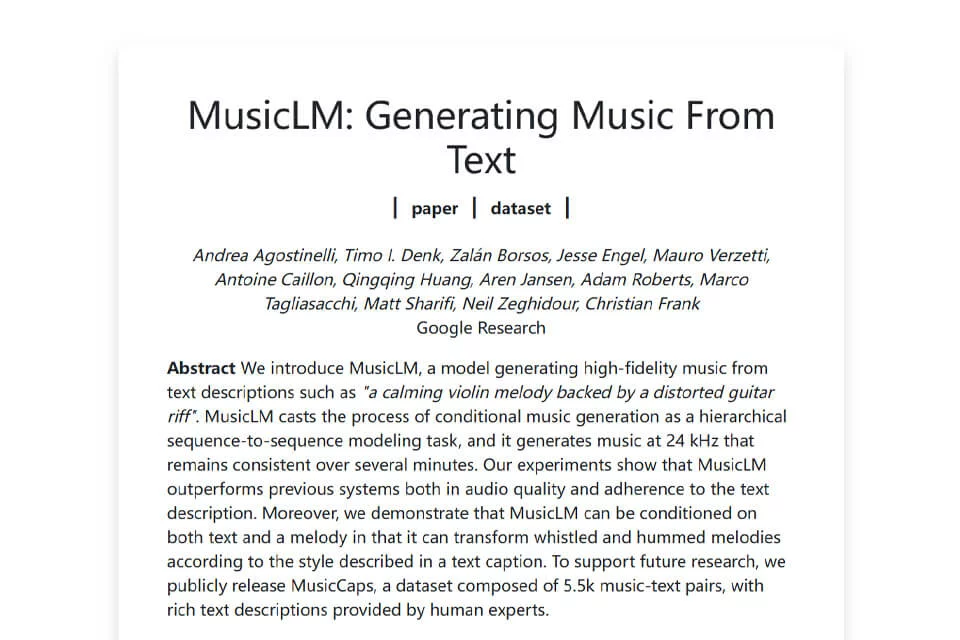
MusicLM is positioned as a text-to-music model that understands descriptions of musical styles, moods, scenes, arrangements, and more, then generates audio accordingly. It is suitable for ideation and prototyping during the early stages of music creation, and can also serve as an experimental subject for research into AI music generation.
Public materials show that MusicLM was also released with the MusicCaps dataset to support research into relationships between music and text.
02Key Features
The product can generate music from detailed text descriptions, such as specifications for an era, genre, instrument combination, or atmosphere. Story mode can use a sequence of descriptions with a time order, allowing the music's mood or style to change with the content.
Melody-conditioned generation accepts melodies that users hum, whistle, or play simply, then rearranges them according to text requirements. Public descriptions also state that it can generate music up to about 5 minutes long with relatively coherent structure and style.
03Use Cases
Music creators and producers can use it to draft arrangement directions, experiment with different styles, or explore new ways to express an existing melody. Film, game, and short-video creators can use it for preliminary scene scoring and atmospheric music tests.
Researchers and developers can refer to the MusicCaps dataset for work on music generation, music understanding, and relationships between text and audio.
04Important Considerations
Generated results are not necessarily finished pieces ready for release. Melody development, section transitions, timbral expression, and prompt matching may still require manual adjustment. For a specific project, first confirm that the output meets the requirements for duration, mood, and arrangement.
Public materials do not clearly specify licensing and commercial terms for every use case here. Before using outputs in advertising, film, games, or other commercial content, check the product page and related licensing information.
© Disclaimer: domains and linked content may change over time. AIEZZ does not control third-party websites. Review external content and risks independently.
User reviews0