

- Monthly visits
- 0
- Pricing
- Free
- Listed
- 2025-11-04
- Updated
- 2026-08-25
01Product Positioning
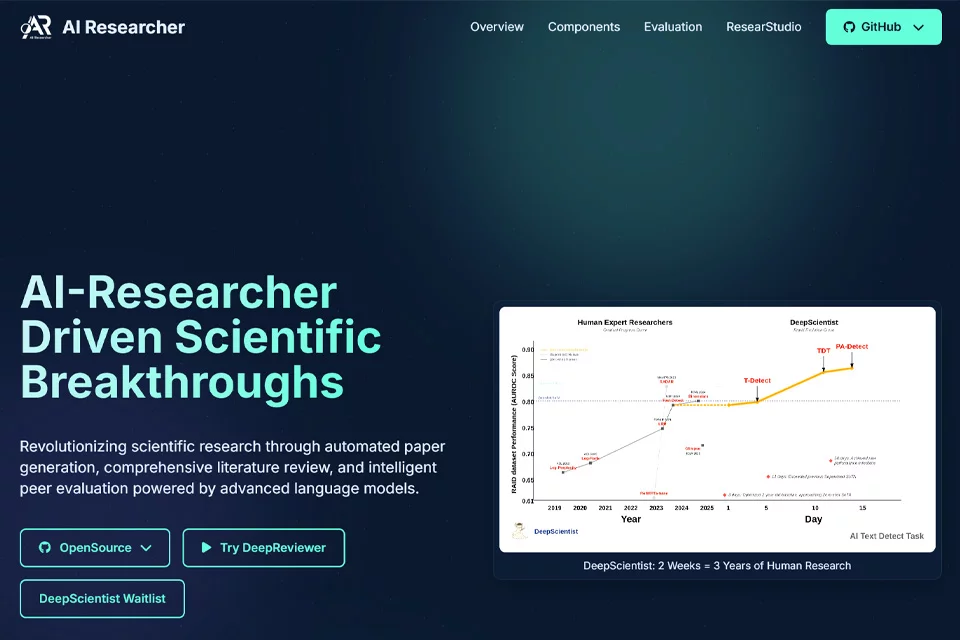
AI Researcher is designed for researchers and attempts to connect topic selection, information research, experimental validation, and paper writing within a single workflow. As an open-source research agent, it provides assistance for research tasks involving substantial amounts of literature, code, and experimental information.
The tool is intended to support the research process rather than replace researchers' final judgment. Users must still review and confirm the value of research questions, the reliability of methods, and the validity of conclusions.
02Key Features
According to available information, AI Researcher can collect, filter, and analyze relevant literature and code from academic databases and code platforms, helping organize research backgrounds and existing methods.
It can also attempt to identify research gaps and generate research ideas based on existing studies, execute experiments in a containerized environment, analyze results, adjust algorithms, and organize structured academic papers from information and results gathered during the research process.
03Use Cases
University faculty, research institute staff, and master's and doctoral students can use it for preliminary literature reviews, research direction planning, experimental approach exploration, and initial paper drafting. Corporate R&D teams can use it for technology research and preliminary validation of research plans, while interdisciplinary researchers can use its information analysis capabilities to quickly understand related work in other fields.
It is best suited as a research aid for projects that require repeated literature review, code execution, and experimental result consolidation.
04Usage Considerations
Automatically generated research ideas, literature summaries, code analyses, and experimental results should not be treated directly as peer-reviewed conclusions. Users should verify literature sources, citations, code execution environments, experimental data, and paper wording item by item, paying particular attention to whether the identified research gaps are accurate.
For real research projects, personnel with relevant domain expertise should also oversee the research design and final conclusions. Available information does not specify database access permissions, runtime environment requirements, or experiment success rates, so these details need to be confirmed based on project conditions before actual use.
© Disclaimer: domains and linked content may change over time. AIEZZ does not control third-party websites. Review external content and risks independently.
User reviews0