

- Company
- Menlo Research
- Product origin
- Singapore
- Open source
- Yes
- Listed on
- 2026-07-27
01About Asimov 1
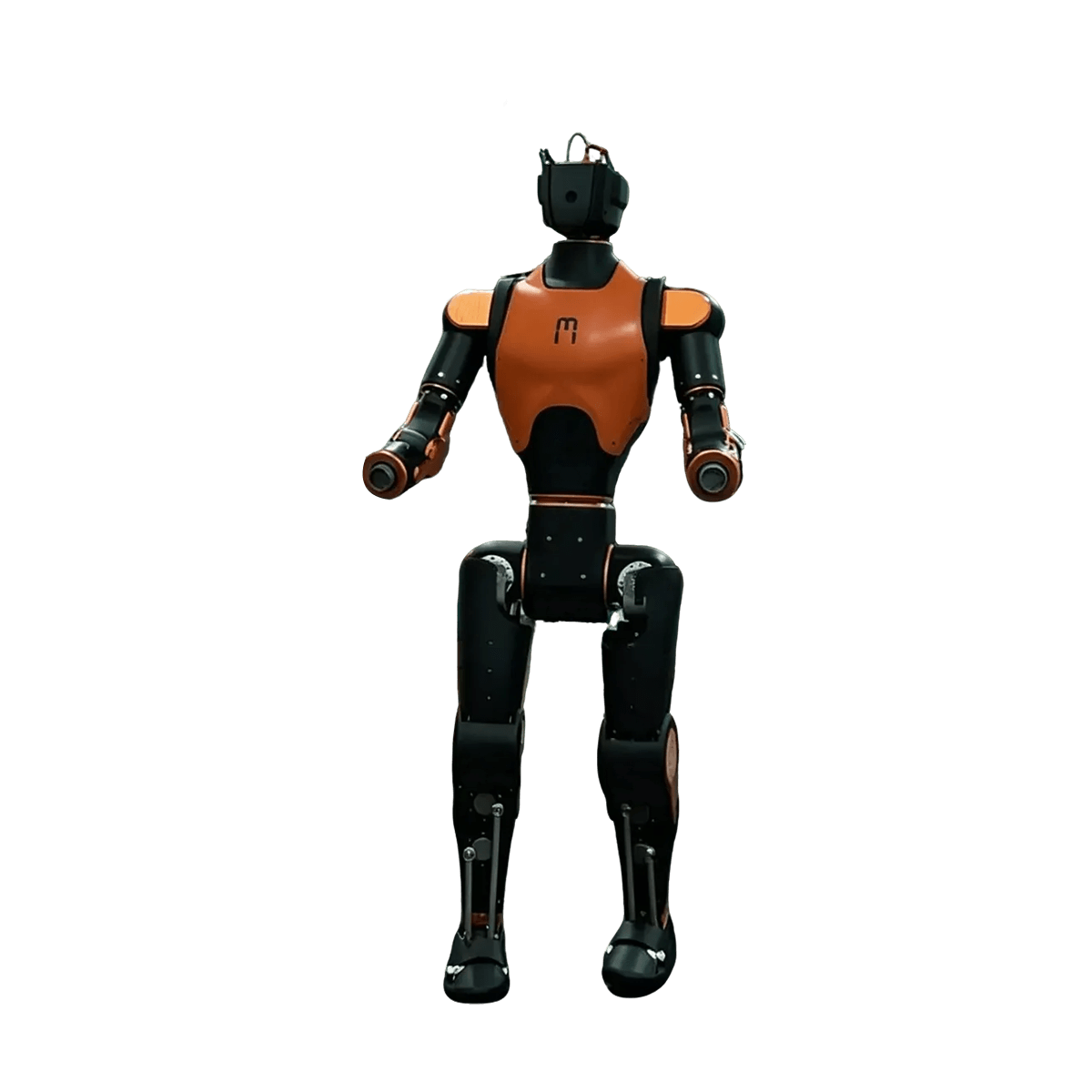
<p>Asimov 1 is a bipedal humanoid robot that you can build from the ground up. Menlo Research made it into a thoroughly open hardware platform—the entire 1.2-meter-tall, 35-kilogram machine, from its aluminum-alloy frame and motor driver boards to its CAN buses and MuJoCo simulation model, is available on GitHub for anyone to inspect, modify, or build from. The robot has 25 active motors plus two passive toe joints, delivers up to 120 Nm of peak torque, can squat while carrying 5 kg, and can hold an 18 kg single-arm lateral raise steadily.</p><p>Its computing system uses two boards with separate roles: a Raspberry Pi 5 handles networking and camera imagery, while a Radxa CM5 is dedicated to real-time motion control. Two CAN buses transmit commands at 1 Mbps for fast response. Assembly takes roughly one hundred hours, including tightening screws, routing cables, and flashing firmware by following the manuals and videos step by step.</p><p>You can purchase the official kit with all parts included, or source everything worldwide using the public BOM and modify the structure and materials to suit your ideas. The MuJoCo simulation environment is also preconfigured. Real-hardware latency and sensor noise are added during training, allowing policies to be deployed to the physical robot more smoothly.</p>
02Asimov 1 Technical Specifications
<p>Core hardware specifications</p>
03Asimov 1 Use Cases
<p>Universities and research institutions: Provides a real hardware validation platform for robotics, reinforcement learning, motion control, and related fields. Researchers can explore every technical detail and collect data from the physical robot.</p><p>AI startups: Replaces million-dollar commercial robot purchases at a lower cost, enabling rapid prototyping and validation of algorithms on real hardware.</p><p>Motion control and reinforcement learning development: Includes a MuJoCo simulation model and processor-in-the-loop training. Policies trained in simulation can be deployed directly to the physical robot.</p><p>Mechanical and electrical engineering education: The complete assembly process is a rigorous hands-on course covering mechanics, electronics, the BOM, and code from start to finish.</p><p>Individual developers and the open-source community: All drawings, code, and bills of materials are publicly available for customization and modification.</p>
04Asimov 1 Advantages
<p>Complete open-source freedom: Hardware is licensed under CERN-OHL-S-2.0, while software uses GPL-2.0. CAD files, schematics, and simulation models are all publicly available.</p><p>Modular and easy to repair: Replace only the damaged component instead of returning the entire robot, keeping maintenance costs more manageable.</p><p>No hardware lock-in: The Raspberry Pi 5 and Radxa CM5 are general-purpose boards, so you can replace the computing modules yourself.</p><p>Smooth sim-to-real transfer: Real-world latency and noise are injected during training, reducing the need for repeated tuning after deployment to the physical robot.</p><p>Complete community resources: The GitHub repository, official forum, assembly manual, and video tutorials are all available.</p>
Disclaimer: This profile is compiled from public information. Refer to official sources for current specifications and capabilities.
Asimov 1Comment
Reviews appear after moderation. Share a specific, genuine product experience.