
- Monthly visits
- 0
- Pricing
- Not set
- Listed
- —
- Updated
- 2026-10-14
01What Is Scion?
Scion is Anthropic's in-house version control system, built to replace Git for managing its massive monolithic repository. Claude-generated code grew 12x in 4 months, while daily merges rose from 2,500 to 30,000, leaving Git infrastructure essentially unable to cope. Scion was redesigned for always-on agents: clients retrieve data from the server on demand, while commits and merges are completed entirely on the server. It supports full horizontal scaling and sparse checkouts. After migration, resource usage fell to 1/200 of the Git-based solution, while checkouts became two orders of magnitude faster.
02Scion's Main Features
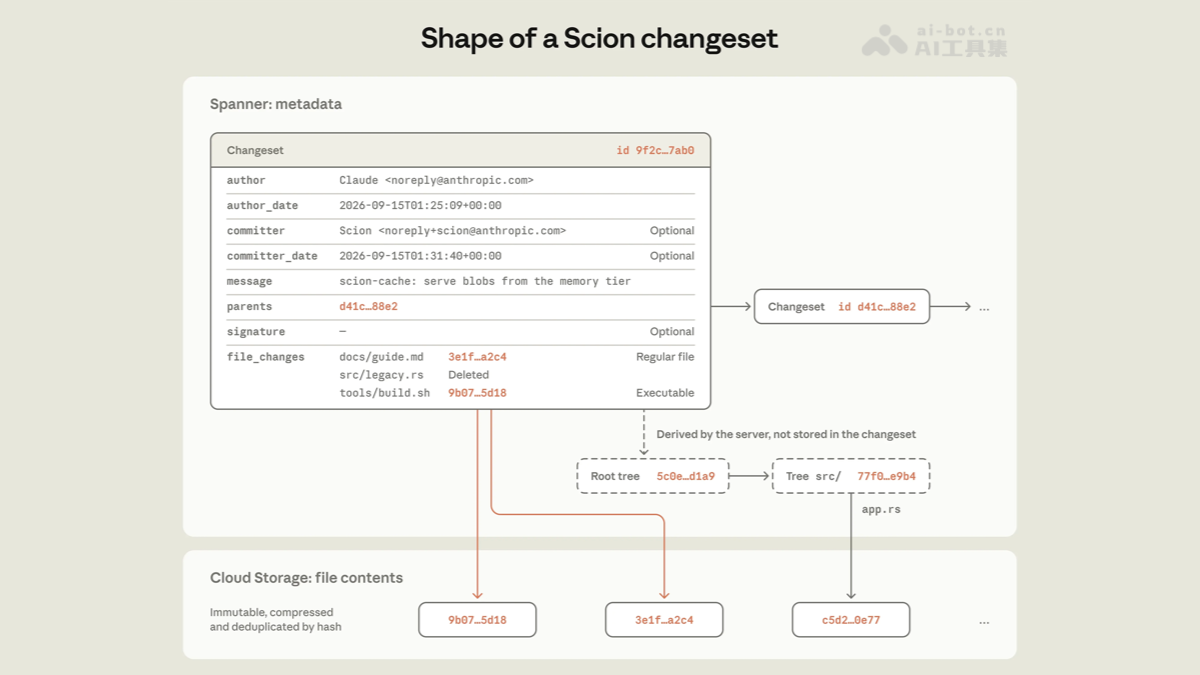
Changesets replace commits: write-ahead log entries record a list of file changes relative to the parent. They are created server-side and immediately available globally, with no need for packing, locking, or reference movement.
Derived data mechanisms: indexes such as blame, path history, and commit-graph skip lists are built recursively from changesets. New data types can be hot-plugged, with support for immediate or deferred computation and no client-side awareness.
Fully API-based source control service: queries such as diff, merge base, and blame are all exposed through RPC, so CI and tools do not need to maintain local repository copies.
Layered checkout caching architecture: scion-daemon (node level) → scion-cache (regional level) → scion-server (authoritative layer) provide progressive caching. Each layer achieves a hit rate above 99%, reducing checkouts from minutes to seconds.
Sparse/virtualized checkouts: clients fetch only files in the requested directories and instantiate them on demand. File contents are retrieved only when actually read.
Fine-grained access control: repository-level and directory-level access controls are supported, combined with the Antique review tool to enforce semantic approval constraints.
Low-cost, incremental, lock-free commits: commit creation cost is proportional to the size of the changes rather than the repository size, while reference updates are an atomic operation on a single Spanner record.
03How to Use Scion
Scion is an internal Anthropic system. It has not been publicly released, so external users cannot download or deploy it.
04Scion's Core Advantages
Extremely low resource usage: CPU and memory consumption are only 1/200 of the original Git mirror infrastructure.
Two orders of magnitude faster checkouts: code checkouts for CI and research tasks dropped from minutes to seconds.
Significant compute savings: CI alone freed up 25% of CPU capacity.
Highly efficient caching: each cache layer achieves a hit rate above 99% and requires no long-term state, making scaling simple.
Extremely high commit throughput: without packfiles, locks, or cross-service coordination, changesets can be received at high throughput, supporting 30,000 merges per day.
No local repositories: all source control queries are provided through APIs, so CI and tools no longer need to maintain local copies.
Full horizontal scaling: there are no complete repository instances or global-state bottlenecks, and each component can scale independently.
Near-zero maintenance cost: without the concept of packfiles, neither clients nor caches need to perform repository maintenance.
Fine-grained security: directory-level access controls and semantic approval constraints protect sensitive code within the large repository.
05Scion's Project URL
Project website: https://www.anthropic.com/engineering/redesigning-source-control
06Scion's Use Cases
High-frequency code submissions by AI agents: after completing coding tasks, agents create changesets directly on the server through the API, without maintaining local repositories, supporting tens of thousands of merges per day.
Large-scale CI without checkouts: CI jobs directly call RPC to retrieve diffs, blame, and merge bases, and can even perform writes without a checkout, so tens of millions of daily checkouts no longer become a bottleneck.
Multi-team collaboration in large monolithic repositories: when tens of thousands of engineers share one repository, sparse checkouts let each person fetch only the directories they own, while directory-level permissions protect sensitive code.
Automated operations and regression identification: automated bisect and revert pipelines use programmatic interfaces to query commit ancestry, enabling large-scale rollbacks of problematic changes.
© Disclaimer: domains and linked content may change over time. AIEZZ does not control third-party websites. Review external content and risks independently.
User reviews0