

- Monthly visits
- 0
- Pricing
- Free & Paid
- Listed
- 2026-01-28
- Updated
- 2026-01-29
01Product Positioning
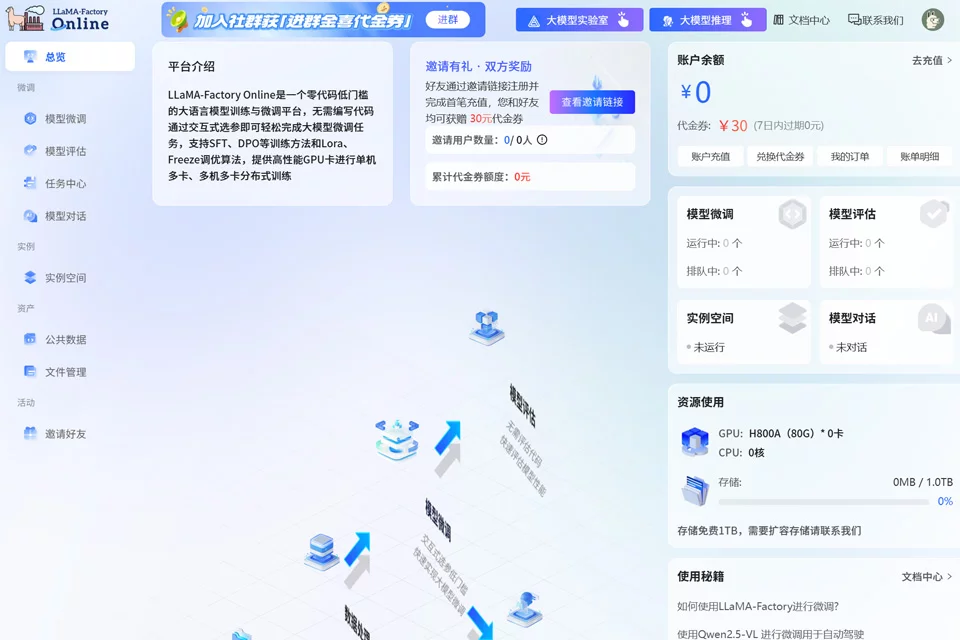
LlamaFactory Online brings the open-source large model fine-tuning workflow to an online web environment, allowing users to work on data preparation, model selection, training configuration, and experiment analysis. It is suitable for developers, business teams, and researchers who want to reduce the effort required to set up a local environment.
The platform offers free and paid plans, but fine-tuning tasks still involve model, data, and computing resource configuration. An online interface should not be treated as an automated service that eliminates the need for technical judgment.
02Key Features
The platform supports a range of mainstream open-source models and covers training methods including pretraining, supervised fine-tuning (SFT), Reward Modeling, PPO, DPO, and KTO.
For parameter configurations, it offers 16bit full-parameter fine-tuning, freeze fine-tuning, LoRA, and QLoRA. QLoRA supports different quantization precisions from 2bit to 8bit. Training can be monitored through tools such as LlamaBoard, TensorBoard, Wandb, Mlflow, and SwanLab. On the inference side, the platform supports the Transformers and vLLM engines.
03Use Cases
Individual developers and technology enthusiasts can use it for open-source model fine-tuning experiments and solution validation, making it suitable for exploratory tasks that require rapid comparison of training configurations.
Startups can use it to adapt business data and customize models, while university faculty and students can apply it to course experiments, research validation, or interdisciplinary projects. Teams that require complex data governance, strict training audits, or deeply customized underlying environments should first confirm that the platform's available configuration range meets their needs.
04Usage Considerations
Actual results depend on training data quality, the model's underlying capabilities, training method, precision settings, and task configuration. The models and algorithm options provided by the platform do not replace the design work required in these areas.
Before training, check data formats, authorization scope, and sensitive information handling requirements, and estimate costs and runtime based on the task scale. For larger models or distributed training tasks, also verify that GPU memory, parallel configuration, monitoring metrics, and inference resources are properly matched.
© Disclaimer: domains and linked content may change over time. AIEZZ does not control third-party websites. Review external content and risks independently.
User reviews0