

- Monthly visits
- 0
- Pricing
- Free
- Listed
- 2025-09-01
- Updated
- 2026-05-16
01Product Positioning
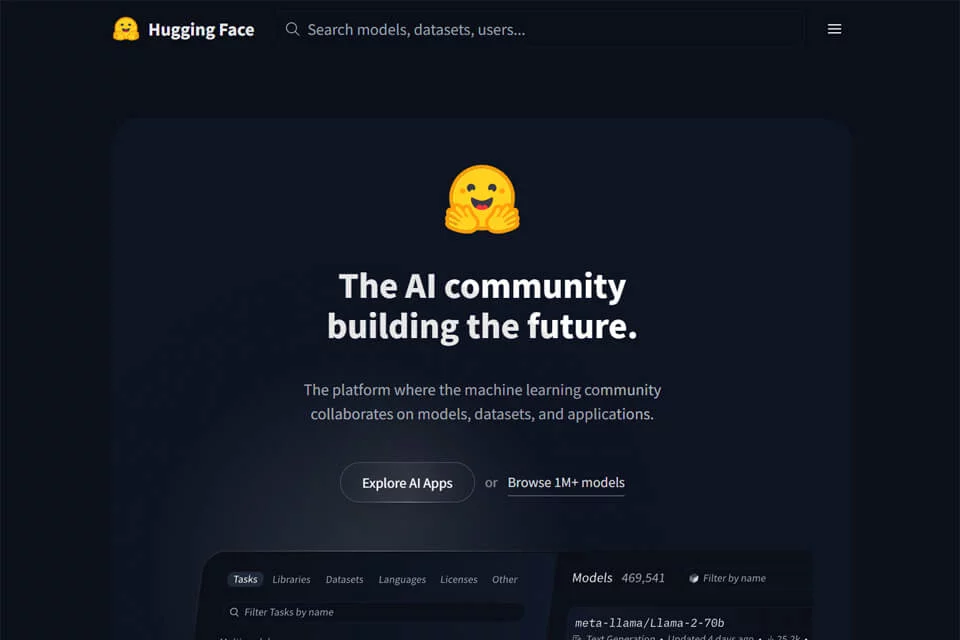
Hugging Face is an open machine learning platform and AI toolkit for developers, researchers, data scientists, and AI learners.
Its resources are organized around models, datasets, and application development, making it suitable for finding existing models, preparing experimental data, validating model performance, and building AI application prototypes.
02Key Features
The model hub provides community-created pretrained models covering areas such as text, images, and audio. The dataset hub is used to store and share data resources needed for model training and evaluation.
The Transformers library provides a unified way to use many mainstream models and supports frameworks such as PyTorch and TensorFlow. Spaces can be used to create and host interactive AI application demos, while inference endpoints target production model deployment by providing managed inference services.
03Use Cases
Learners can use existing models, datasets, and documentation to understand machine learning workflows and conduct basic experiments. Researchers can use the platform's resources for model comparisons, data processing, and fine-tuning.
Developers can integrate model capabilities into their own applications or use Spaces to showcase interactive project prototypes. When preparing for production deployment, teams can further evaluate whether managed services such as inference endpoints meet their project needs.
04Usage Considerations
Models and datasets on the platform come from different contributors, so their quality, maintenance status, dependencies, and intended uses may vary. Before selecting a resource, read the model card, dataset documentation, and related materials, then validate its performance in the target environment.
Tools such as Transformers generally still require relevant programming knowledge and a suitable runtime environment. Spaces are well suited to application demos, while production deployment should be evaluated separately based on model size, resource requirements, and service needs.
© Disclaimer: domains and linked content may change over time. AIEZZ does not control third-party websites. Review external content and risks independently.
User reviews0