- Monthly visits
- 0
- Pricing
- Free & Paid
- Listed
- 2025-10-25
- Updated
- 2026-08-25
01Product Positioning
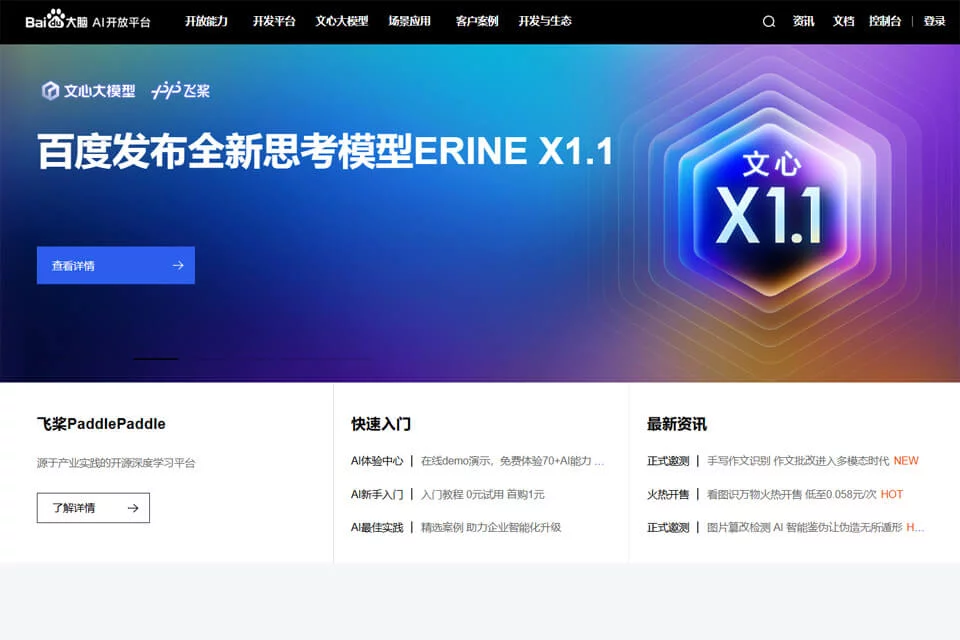
The Baidu AI Open Platform is an open AI capabilities service for developers and enterprises. It provides models and specific technical capabilities to application developers through APIs, SDKs, and other methods.
The platform covers foundational AI APIs, foundation model capabilities, and solutions for selected industries. It is suitable for teams that need to integrate intelligent capabilities into existing systems or new applications.
02Key Features
The platform provides a wide range of AI technology APIs, including speech, computer vision, natural language processing, and knowledge graphs. The available materials state that the number of APIs reaches several hundred.
The ERNIE series foundation models can be used for tasks such as content creation, intelligent Q&A, and logical reasoning. The platform also provides support for AI development, model training, and application deployment, with some solutions targeting smart hardware, healthcare, and enterprise services.
03Use Cases
Developers and enterprises can call APIs or integrate SDKs to add Q&A, text generation, voice interaction, image recognition, and other functions to websites, business systems, and other applications.
Research institutions and universities can use the models, computing resources, or datasets provided by the platform for learning and research. Smart hardware manufacturers can explore voice interaction and visual recognition in products such as robots and wearable devices. Industry integrators can use these capabilities to package application solutions for fields including finance, healthcare, and education.
04Usage Considerations
Before use, confirm that the target API, model capabilities, and invocation method meet the project requirements. Complete authentication, parameter configuration, and result processing according to the documentation. Foundation model outputs and recognition results still require validation against the specific business context and cannot directly replace human review or industry processes.
Although the platform provides support from development through deployment, customized applications still require capabilities in API integration, data processing, and engineering deployment. For professional scenarios such as healthcare, business regulations and responsibility for use should also be evaluated separately.
© Disclaimer: domains and linked content may change over time. AIEZZ does not control third-party websites. Review external content and risks independently.
User reviews0