

- Monthly visits
- 0
- Pricing
- Free
- Listed
- 2025-11-20
- Updated
- 2026-08-25
01Product Positioning
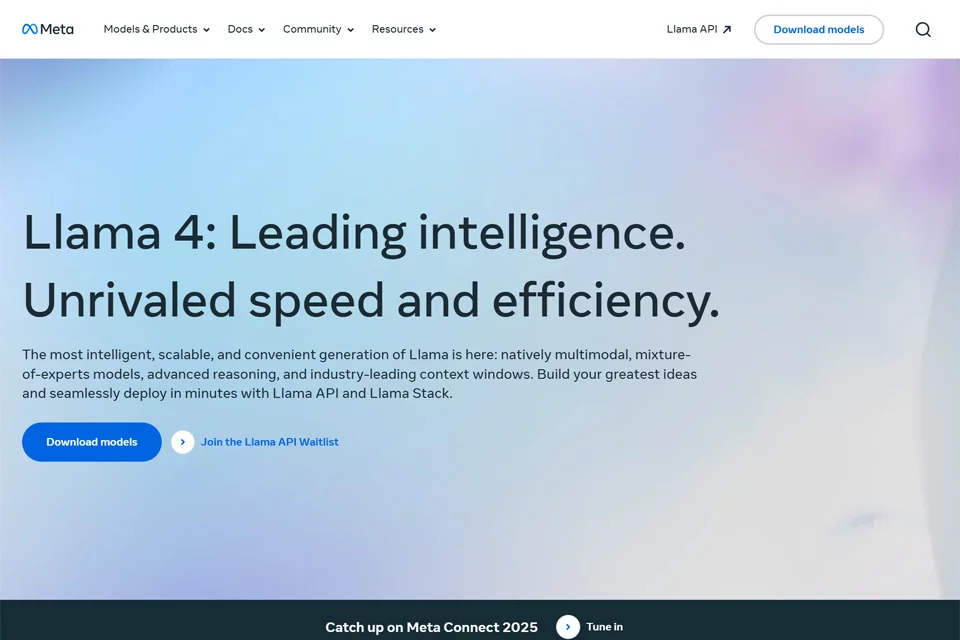
Llama 4 is an open-source multimodal foundation model for developers and researchers, rather than merely a text generation tool. Its native multimodal architecture covers text, image, video, and audio processing, while its mixture-of-experts (MoE) design is used to build model variants with different capabilities and scales.
The product targets AI application development, academic research, enterprise technology teams, and independent creators, and supports local and private deployment.
02Key Features
The model supports context inputs of up to approximately 10 million tokens and can be used to analyze long documents, codebases, and other continuous source material. Variants such as Scout and Maverick are available for different deployment and task requirements.
In addition to multimodal tasks, available materials state that Llama 4 has been enhanced for code processing and logical reasoning. It can be used for code analysis, refactoring assistance, content summarization, and cross-modal understanding. Specific results vary with the model variant and runtime environment.
03Use Cases
Developers can use Llama 4 as an underlying model for applications that need to process text, images, and other content. Researchers can conduct experiments involving multimodal fusion and mixture-of-experts architectures.
Enterprise technology teams can analyze internal documents or code in private environments, while creators can use it to organize long-form text, summarize video scripts, and assist with image-and-text content processing.
04Usage Considerations
Before deployment, confirm the VRAM, storage, and inference environment requirements for the selected variant. Support for local execution does not mean that every version is suitable for ordinary devices; extremely long contexts may also increase resource consumption and processing costs.
Outputs involving code, enterprise documents, or multimedia content should be manually verified against the original materials, with particular attention to factual accuracy, context selection, and sensitive information handling.
© Disclaimer: domains and linked content may change over time. AIEZZ does not control third-party websites. Review external content and risks independently.
User reviews0