

- Monthly visits
- 0
- Pricing
- Free & Paid
- Listed
- 2026-02-20
- Updated
- 2026-08-25
01Product Positioning
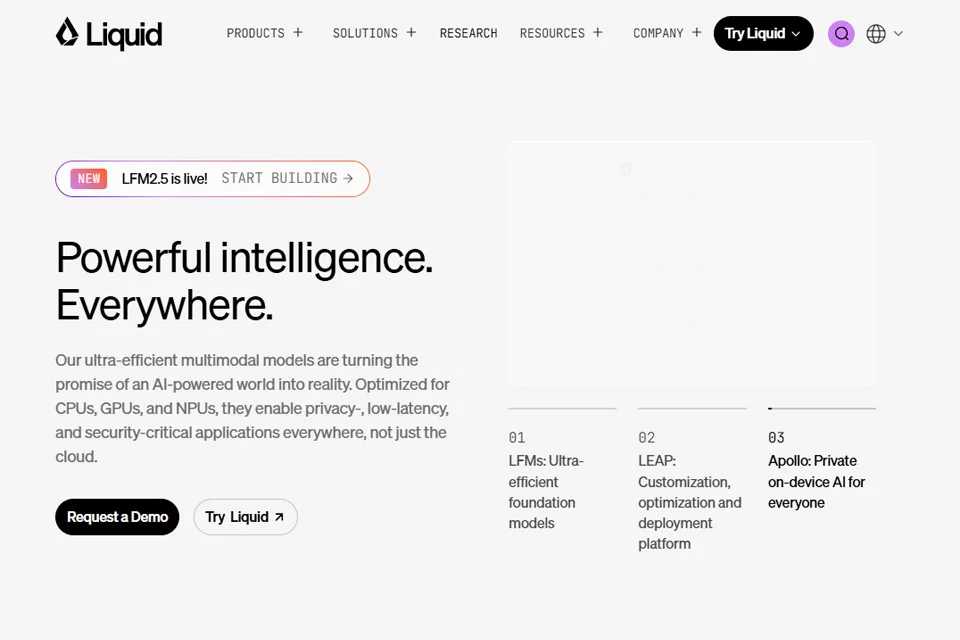
Liquid AI is an AI toolkit for edge deployment, with Liquid Foundation Models (LFMs) as its core products. Models are available in sizes including 350M, 700M, 1.2B, and 2.6B parameters, targeting devices such as phones, laptops, cars, and robots.
The platform also provides the LEAP developer platform and the Apollo mobile app, serving model development and deployment, and mobile experience testing, respectively.
02Key Features
LFMs support text, vision-language, audio, and other model types for multimodal application development. LEAP provides workflows for model downloads, custom fine-tuning, and on-device deployment, helping developers move from model selection to runtime execution on end devices.
Related models are available on Hugging Face; platform materials also mention access through OpenRouter. Device support covers GPUs, CPUs, and NPUs, while specific capabilities depend on the model and hardware combination.
03Use Cases
Independent developers and researchers can download models for local experiments, model testing, or edge application prototyping. Apollo is suited to experiencing and validating small language models on phones, while LEAP is better suited to development workflows requiring fine-tuning and deployment.
Startups, large enterprises, and hardware manufacturers can use the models for in-vehicle systems, consumer electronics, wearable devices, robots, and other end-device solutions, assessing model size and deployment methods based on device conditions.
04Usage Considerations
Local execution requires suitable computing resources, runtime environments, and device adaptation. As model parameter size increases, deployment conditions generally become more complex. Before use, evaluate the target device's GPU, CPU, or NPU capabilities and confirm the model type, memory requirements, and latency targets.
The platform offers free and paid options, but specific plans, service scope, and fees should be verified on the official pages. Model performance also varies with the task, data, and fine-tuning method, so parameter size alone cannot determine whether a model is suitable for production.
© Disclaimer: domains and linked content may change over time. AIEZZ does not control third-party websites. Review external content and risks independently.
User reviews0