
- Monthly visits
- 0
- Pricing
- Not set
- Listed
- —
- Updated
- 2026-10-26
01What Is Hi3D 1.0?
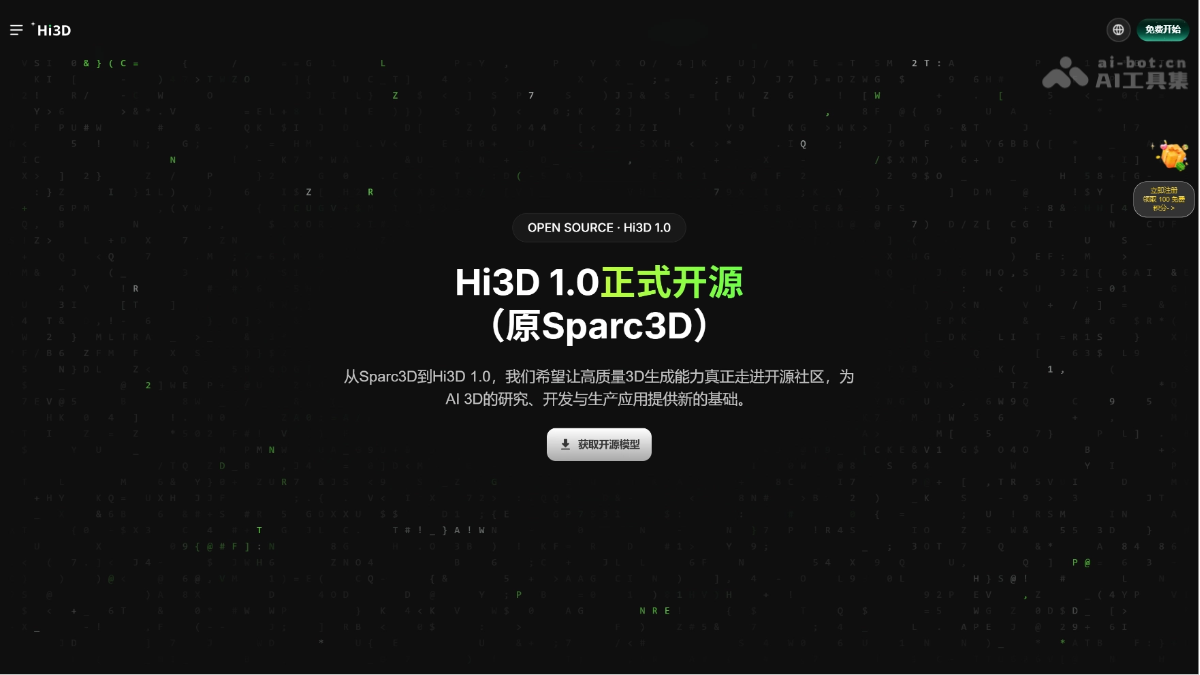
Hi3D 1.0 is Math Magic's open-source Chinese AI 3D generation model, with technology derived from Sparc3D, presented at NeurIPS 2025. Hi3D 1.0 was trained on approximately 2 million curated 3D assets and uses a sparse geometry refinement architecture. It supports progressive refinement from 512³ to 1024³ to 1536³, generating high-resolution watertight meshes from a single image. Its multiview fidelity and richness of detail rank first among comparable methods, with a slicing success rate of 90%, allowing results to go directly into the 3D printing workflow.
02Key Features of Hi3D 1.0
Single-image 3D generation: Input one reference image to generate a complete 3D model, with reasonable completion of unseen back and occluded areas.
High-resolution geometry refinement: Supports progressive refinement from 512³ to 1024³ to 1536³, rendering fine structures such as individual feathers and tire treads with exceptional clarity.
3D-printing ready: Outputs watertight meshes with a 90% slicing success rate, ready to enter the print preparation workflow. Parts can be separated, connection structures designed, and colors applied automatically.
Agent-assisted editing: Use natural-language dialogue to adjust shapes, local structures, textures, and meshes; fix floating and connection errors; and optimize for printing, games, animation, and other targets.
End-to-end application delivery: Generated results can be downloaded for further processing in Blender and game engines, rigged with skeletons, animated with facial expressions and movements, or converted into physical works such as collectible figures and designer toys.
Open integration capabilities: The open-source model supports private deployment, the MCP interface enables external Agents to invoke generation tasks, and Hi3D Agent directly serves creators.
03How Hi3D 1.0 Works
Follow on WeChat and reply with “开源” to join the AI open-source project community.
Sparse geometry representation (Sparcubes + Sparconv-VAE): Hi3D inherits Sparc3D's core architecture and represents 3D shapes sparsely, retaining only valid voxels near the object's surface. Latent features evolve on coarse surface coordinates and are decoded by a self-pruning VAE to extract the mesh. This preserves complex geometric details while greatly reducing memory and computational costs at high resolutions.
Progressive multilevel refinement: The upstream model first generates a coarse mesh from the image to determine the overall silhouette and primary components. Hi3D then references both the image and coarse mesh for sparse geometry refinement. After each level, it extracts a mesh and uses it as the basis for the next refinement round, progressively moving from 512³ to 1024³ and 1536³ to “establish the overall structure first, then render details level by level.”
Large-scale training and production validation: The training data was expanded from the 500,000 assets used in the Sparc3D paper to approximately 2 million curated 3D assets. This exposes the model to a broader range of object structures and provides more extensive training examples for inferring unseen areas such as the back of an object. Before release, it also underwent testing in real production workflows to ensure that generated assets could be further processed and used in downstream applications.
04How to Use Hi3D 1.0
Method 1: Free online experience. Open the experience page: visit the Hugging Face Space (https://huggingface.co/spaces/ilcve21/Sparc3D) or the official open-source page https://www.hi3d.ai/hi3d-1-0-open-source.
Upload a reference image: Provide an image of the target object, which the model will use as the visual basis for generating a 3D model.
Wait for generation and review the result: The system automatically performs progressive refinement from a coarse mesh through 512³ to 1024³ to 1536³, allowing you to view the result from multiple angles online.
Download and use: Download the generated mesh as a model file, then import it into Blender, a game engine, or other software for further processing, or use it directly for 3D printing.
Method 2: Local deployment of the open-source model. Obtain the code and weights: Clone the code from GitHub (https://github.com/hi3d-official/Hi3Dv1.0) and download the model weights from Hugging Face.
Configure the environment: Install dependencies, prepare a GPU runtime environment, and load the self-pruning VAE and sparse refinement model.
Input the image and coarse mesh: Call the inference interface with the reference image and the coarse mesh generated by the upstream model to perform sparse geometry refinement.
Extract and output the mesh: Extract watertight mesh results by level. You can stop at any resolution level or use the result as the basis for the next refinement round.
05Core Advantages of Hi3D 1.0
Production-grade accuracy: With an output resolution of 1536³, it renders fine structures such as feathers and tire treads with exceptional clarity. Its multiview fidelity and richness of detail both rank first among comparable methods.
True watertight meshes: Outputs can be sliced and printed directly, with a 90% slicing success rate, eliminating complicated mesh repair between generation and physical production.
Open source and commercially usable: The code and weights are fully open and have been validated in real production workflows, enabling enterprises to deploy privately and develop further with confidence.
Specialized model division of labor: In comparative tests against general-purpose large models such as GPT-6 Astra, it delivers comprehensive advantages in silhouette, volumetric relationships, and detail reproduction, validating the division of labor in which “LLMs manage intent and specialized models manage generation.”
End-to-end coverage: From single-image generation and conversational editing to rigging, game integration, and part separation for printing, it connects the complete “generation-editing-application” creative workflow.
Open integration ecosystem: It provides an MCP interface for external Agents while using Hi3D Agent to serve everyday creators, supporting both developers and end users.
06Hi3D 1.0 Project Links
Official website: https://www.hi3d.ai/zh/hi3d-1-0-open-source
GitHub repository: https://github.com/hi3d-official/Hi3Dv1.0
Hugging Face model page: https://huggingface.co/spaces/ilcve21/Sparc3D
07Hi3D 1.0 Use Cases
3D printing and collectible figures: Automatically separate parts, design connection structures, and apply colors after generating watertight meshes, enabling direct printing of collectible figures, designer toys, and other physical works.
Game development: Quickly generate character, prop, and environment assets, bring them into interactive environments, and advance to playable demos, significantly shortening the prototyping cycle.
Animation and real-time content: Optimize static characters, add rigs, and process movements and facial expressions so they can enter animation or real-time rendering pipelines.
Film, television, and digital sculpture: Reconstruct and upscale complex, sculpture-grade models at high resolution while preserving fine structures such as feathers and armor textures to support digital art creation.
Enterprise private vertical applications: Deploy the open-source model in internal systems to build customized workflows for e-commerce 3D product displays, educational courseware, industrial part modeling, and more.
© Disclaimer: domains and linked content may change over time. AIEZZ does not control third-party websites. Review external content and risks independently.
User reviews0