
- Monthly visits
- 0
- Pricing
- Free & Paid
- Listed
- 2025-10-25
- Updated
- 2026-08-25
01Product Positioning
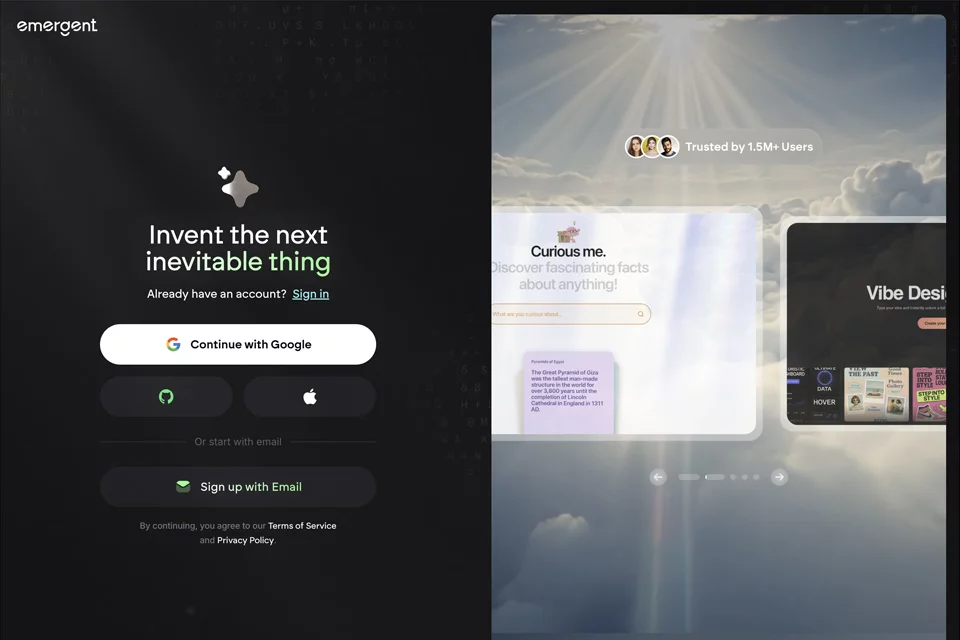
Emergent uses natural-language conversation as the entry point to software development, with multiple AI agents collaborating across the process from requirements planning through deployment. It is positioned as an end-to-end AI coding tool rather than merely a generator of code snippets.
The product is suitable for quickly turning ideas into interactive applications, and can also support certain software maintenance and engineering automation tasks. Projects requiring precise architectural control, complex permission design, or strict release processes should still be evaluated and approved by developers.
02Key Features
Users can describe application requirements through conversation and continue iterating in follow-up exchanges. The platform supports generating full-stack application components including frontend interfaces, Python backends, databases, user authentication, and payments.
According to available information, Emergent can also assist with upgrading legacy libraries, refactoring code, increasing test coverage, and building ETL data pipelines. Application results can be output as iOS and Android app packages, and integrated with GitHub for further development or migration.
03Use Cases
Entrepreneurs and product managers can use it to build minimum viable products, support market validation, or demonstrate product workflows. Business users in marketing and operations can try building internal tools or customer portals, reducing reliance on routine development work.
Enterprise engineering teams can use it for legacy system maintenance, technology stack upgrades, and repetitive engineering tasks. Developers and technology enthusiasts can explore conversational development workflows with it, but conventional code review and testing should remain in place for production systems.
04Important Considerations
When using the platform, describe business goals, data structures, permission rules, and acceptance criteria as clearly as possible, then refine the generated result through multiple rounds of conversation. The more ambiguous the natural-language description, the more the application's structure and implementation details require manual confirmation.
Before release, carefully check code logic, third-party service configuration, payment flows, authentication permissions, database operations, and mobile build results. The ability to generate a complete application does not mean a project is ready for direct production use; complex systems still require developers, testers, and operations staff to verify the results.
© Disclaimer: domains and linked content may change over time. AIEZZ does not control third-party websites. Review external content and risks independently.
User reviews0