- Monthly visits
- 0
- Pricing
- Not set
- Listed
- —
- Updated
- 2026-09-04
01What Is Muse Spark 1.3?
Muse Spark 1.3 is Meta's next-generation large language model, personally endorsed by Zuckerberg and positioned as a major breakthrough for Meta in coding and agent tasks. The model is especially strong at code understanding and long-context processing, while significantly reducing tool calls and token usage. It also offers developers API access at highly competitive prices.
02Key Features of Muse Spark 1.3
Long-running agent workflows: Supports long-running, open-ended tasks; autonomously gathers context, organizes clues from messy information, identifies gaps in plans and adjusts proactively, and continuously records its state until delivery.
Enhanced coding capabilities: Optimized for long-running coding tasks, reducing unnecessary conversational turns and producing cleaner code, with outstanding performance in codebase understanding and terminal-based programming.
Complex instruction following: Reliably remembers earlier requirements throughout tasks with multiple steps and constraints, reducing the risk of missed conditions or process deviations later in the task.
Long-context processing: Supports a 1M-token context window with extremely high accuracy for long-text retrieval.
Improved human-AI collaboration: Proactively asks users for clarification when instructions are ambiguous, requests help when blocked, and confirms before performing irreversible operations.
Greater cost efficiency: Uses approximately 20% fewer tool calls and approximately 25% fewer tokens to complete the same task.
03The Technology Behind Muse Spark 1.3
Post-training and test-time scaling: Further post-trained from the Avocado model while strengthening test-time scaling, allowing the model to dynamically allocate more computing resources during inference to improve output quality.
Multi-environment agent training: Trained in a variety of different agent harnesses, enabling it to maintain similar capabilities after leaving a specific environment.
Capability-boundary alignment: Meta specifically strengthened training on the model's awareness of its own capability boundaries, enabling it to more accurately distinguish what it knows, does not know, can do, and cannot do. When blocked, it clearly communicates the limitation instead of fabricating results.
Long-horizon coding task data: Added substantial training data from long-running coding tasks and optimized the model for usability in everyday engineering scenarios, making it more efficient and restrained in real-world development workflows.
04How to Use Muse Spark 1.3
Muse Code terminal programming: Run curl -fsSL https://dev.meta.ai/install.sh | bash in the terminal to install Muse Code, then call Muse Spark 1.3 directly as the underlying model in coding workflows.
Meta Model API integration: Developers can call the model directly through the official API. Standard pricing is $1.25 per million input tokens and $4.25 per million output tokens.
Contributor discount tier: Enabled by default after installing Muse Code, with low pricing of $0.10 for input and $0.20 for output. In exchange, prompts and code outputs may be used by Meta for training; users can manually opt out.
Third-party platform integration: Partner platforms such as Vercel AI Gateway already integrate Muse Spark 1.3, making it easy to add to existing workflows.
05Core Advantages of Muse Spark 1.3
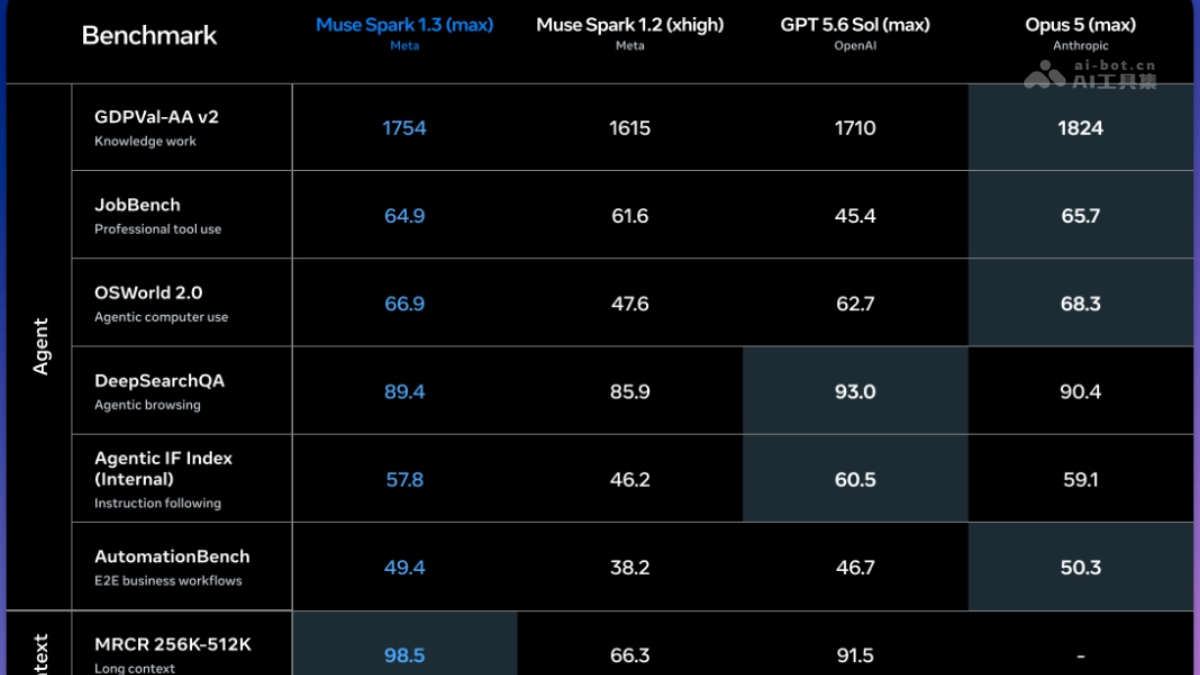
Leading coding capabilities: Ranks first in multiple coding benchmarks, including DeepSWE, SWEAtlas, and Terminal-Bench, surpassing GPT-5.6 Sol and Claude Opus 5.
Exceptionally strong long-context performance: Supports a 1M-token context and achieves over 98% accuracy in long-text retrieval, significantly ahead of competitors.
Superior cost efficiency: Uses approximately 20% fewer tool calls and approximately 25% fewer tokens for the same tasks, while API pricing is far below that of comparable models.
Autonomous long-running agent tasks: Autonomously gathers information, identifies gaps in plans and adjusts proactively, and maintains state throughout complex, open-ended tasks.
More natural human-AI collaboration: Proactively asks for clarification when instructions are ambiguous, requests help when blocked, and confirms before performing irreversible operations.
Highly competitive value: Standard pricing is only approximately one-fifth that of Claude Opus 5, while the Contributor discount tier is “almost negligible.”
06Use Cases for Muse Spark 1.3
AI-assisted software development: Use Muse Code for complex code generation, cross-file debugging, and large-scale codebase understanding, with significantly fewer tool calls and lower token usage.
In-depth long-document analysis: Use the 1M-token context window to process text containing millions of Chinese characters, perform cross-chapter information extraction and correlation analysis, and conduct precise retrieval.
Long-term personal agent task management: Continuously tracks user goals, autonomously gathers information, identifies gaps in plans and adjusts strategies proactively until the final result is delivered.
Complex engineering report generation: Integrates heterogeneous data from multiple sources, such as CFD simulation results and CAD models, to automatically generate structured professional reports in a specified format.
© Disclaimer: domains and linked content may change over time. AIEZZ does not control third-party websites. Review external content and risks independently.
User reviews0