
- Monthly visits
- 0
- Pricing
- Free & Paid
- Listed
- 2026-08-11
- Updated
- 2026-08-11
01What Is GPT-5.6-Cyber?
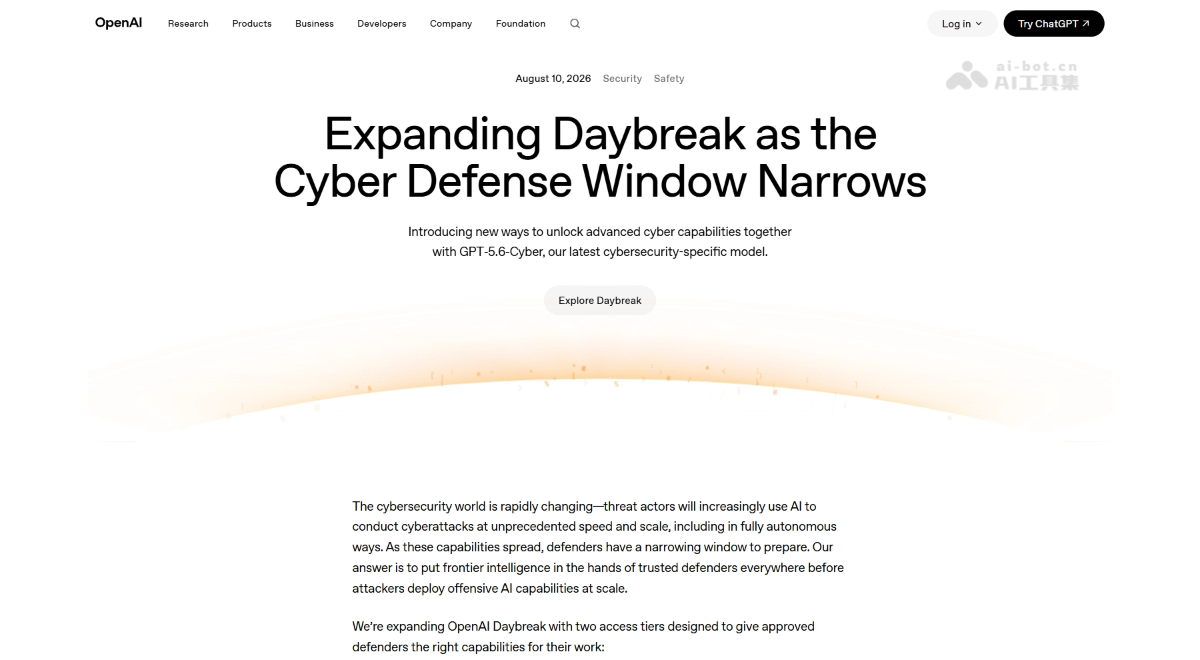
GPT-5.6-Cyber is OpenAI's AI model developed specifically for cybersecurity. It is built on GPT-5.6 Sol and enhanced for specialized tasks such as exploit development and privilege escalation. The model is available only to vetted customers at the Daybreak Red level, with a response rate of up to 95% for advanced security requests. The model is rated “High” in OpenAI's security evaluations and has not breached higher-risk thresholds. It has been integrated into the security products and managed services of leading vendors including Accenture, IBM, and CrowdStrike.
02Key Features of GPT-5.6-Cyber
Exploit validation: Supports advanced vulnerability research and validation tasks, including exploit-chain development, authentication bypass, and privilege escalation.
High response rate: Responds to up to 95% of advanced cybersecurity requests, significantly exceeding the 1.5%–2% rate of the standard version.
Security testing: The Red level provides a specially trained cybersecurity model for in-depth security testing and vulnerability research.
Baseline protection: The Blue level provides routine defensive services, including incident response, malware analysis, and patch validation.
Ecosystem integration: Enables partners such as Accenture, IBM, and CrowdStrike to embed the model into their own security products and managed services.
03How GPT-5.6-Cyber Works
Model foundation: Built on the GPT-5.6 Sol architecture, with targeted enhancement and fine-tuning for specialized cybersecurity tasks.
Guardrail strategy: System-level cybersecurity guardrails are removed at the Blue level, while the Red level further opens access to the full capabilities of the frontier model.
Security evaluation: Under the OpenAI Preparedness Framework, it reaches only the “High” cyber capability threshold and does not reach higher risk levels.
Capability boundary: Its capabilities are significantly below those of the Astra model, whose release was delayed after surpassing a critical hacking threshold, keeping it within a controllable range.
Targeted access: The model is available only to approved “trusted customer partners,” with tiered access controls used to reduce misuse risks.
04How to Use GPT-5.6-Cyber
Individual applications: Visit the GPT-5.6-Cyber website at https://openai.com/zh-Hans-CN/daybreak/ and submit identity verification. After approval, you will receive access to the corresponding tier.
Enterprise applications: Submit an enterprise application through an OpenAI sales representative. Teams can obtain unified access to Daybreak services and Codex Security integration.
Security requirements: Starting September 1, 2026, all Daybreak individual accounts must use hardware security keys. The highest tier must enable phishing-resistant multifactor authentication.
Connect to Codex Security: Connect enterprise code repositories. The system automatically builds threat models, scans for vulnerabilities, validates exploitability in an isolated sandbox, and generates remediation recommendations for human review.
Task execution: The Blue level performs vulnerability discovery, secure code review, malware analysis, incident response, and patch validation. The Red level performs authorized vulnerability research, exploit validation, penetration testing, and red-team exercises.
Patch validation: AI-generated remediation plans require human review and confirmation. After remediation, the system automatically validates the fix and generates an audit-ready evidence chain.
05Core Advantages of GPT-5.6-Cyber
Fewer restrictions: Removes system-level cybersecurity guardrails and responds to up to 95% of advanced security requests, far exceeding the 1.5%–2% rate of the standard version.
Controllable capabilities: Reaches only the “High” level in OpenAI's security evaluation framework and has not breached higher-risk thresholds, keeping it within a controllable range.
Frontier access: Gives defenders early access to and the ability to study cutting-edge AI security capabilities, shortening the response window to autonomous cyberattacks.
Ecosystem integration: Leading security vendors can connect directly to the model and provide support to customers, creating a complete defense chain from model to product.
06GPT-5.6-Cyber Project URL
Official website: https://openai.com/index/expanding-daybreak-as-the-cyber-defense-window-narrows/
07GPT-5.6-Cyber Use Cases
Vulnerability research and validation: Used for advanced vulnerability research and validation tasks, including exploit-chain development, authentication bypass, and privilege escalation.
Enterprise security operations: Supports security operations centers (SOCs) with routine defensive work such as incident response, malware analysis, and patch validation.
Red-team exercises: Enables enterprise red teams to conduct simulated attacks and penetration tests, exposing system weaknesses in advance.
Security product integration: Vendors including Accenture, IBM, and CrowdStrike have embedded it into their own security products and managed services, delivering AI-enhanced protection directly to end customers.
APT simulation: Simulates advanced persistent threat (APT) attack paths to help defenders validate the effectiveness of defense-in-depth systems.
© Disclaimer: domains and linked content may change over time. AIEZZ does not control third-party websites. Review external content and risks independently.
User reviews0