

- Monthly visits
- 0
- Pricing
- Free & Paid
- Listed
- 2025-12-11
- Updated
- 2026-08-25
01Product Positioning
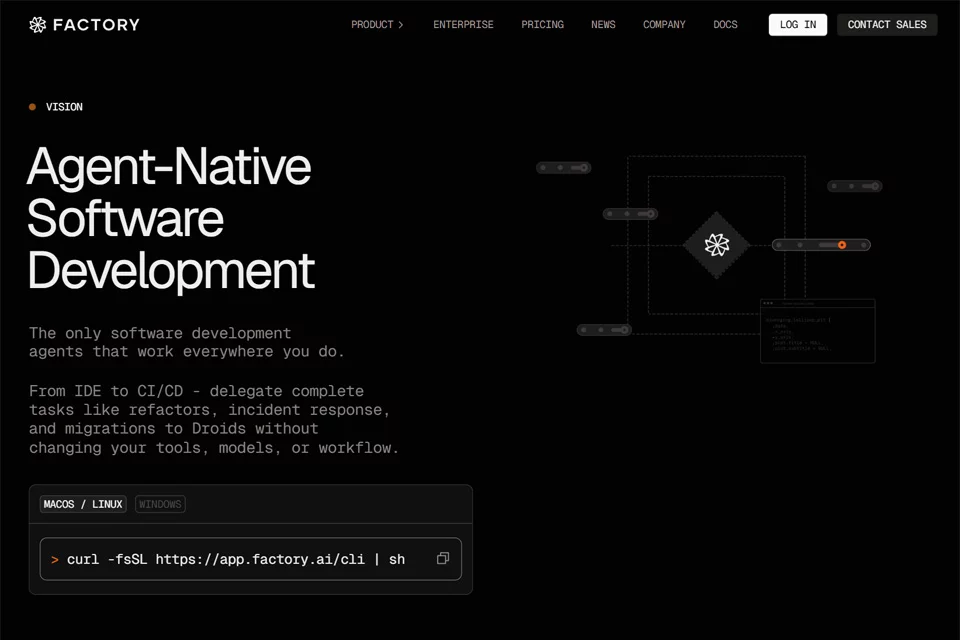
Factory AI is designed for development teams and positioned as an AI development assistant covering the software engineering workflow. It handles more than isolated code generation, aiming to understand codebases around project tasks, perform development work, and connect requirements, implementation, and delivery.
The tool is suitable for startup teams, enterprise R&D teams, and technical operations teams seeking to reduce repetitive engineering work. For large or incompletely documented codebases, sufficient project context should be provided before use.
02Key Features
According to available information, Factory AI's Droids can start from natural-language requirements or task descriptions and participate in coding, testing, deployment, and code review. Its codebase research capabilities retrieve project code and documentation to help users answer technical questions spanning multiple files or modules.
Product materials also mention uses such as troubleshooting and organizing product requirements, including analyzing alerts, locating problems, and turning scattered discussions into structured requirements. The specific execution scope depends on project permissions and configuration.
03Use Cases
Startup teams can use it for product prototyping, feature iteration, and repetitive engineering tasks; enterprise engineers can use it to help understand legacy code, modify modules, and add tests.
For DevOps and operations teams, it can support alert analysis, incident localization, and troubleshooting. Distributed teams can also use it for code review, technical information retrieval, and requirements organization, reducing communication costs caused by waiting and dispersed information.
04Usage Considerations
Factory AI covers connected steps including code modification, testing, and deployment. Before use, define the task scope, runtime environment, and validation criteria, and check its impact on existing code and configuration. For production systems, permission changes, or live incident response, retain human approval and a rollback plan.
Generated code and analytical conclusions cannot replace engineers' judgment regarding business logic, dependencies, test results, and security risks. For projects with insufficient context, missing documentation, or ambiguous requirements, the output may require multiple rounds of correction.
© Disclaimer: domains and linked content may change over time. AIEZZ does not control third-party websites. Review external content and risks independently.
User reviews0