
- Monthly visits
- 0
- Pricing
- Free & Paid
- Listed
- 2026-08-05
- Updated
- 2026-08-05
01What Is MAGI-2-preview?
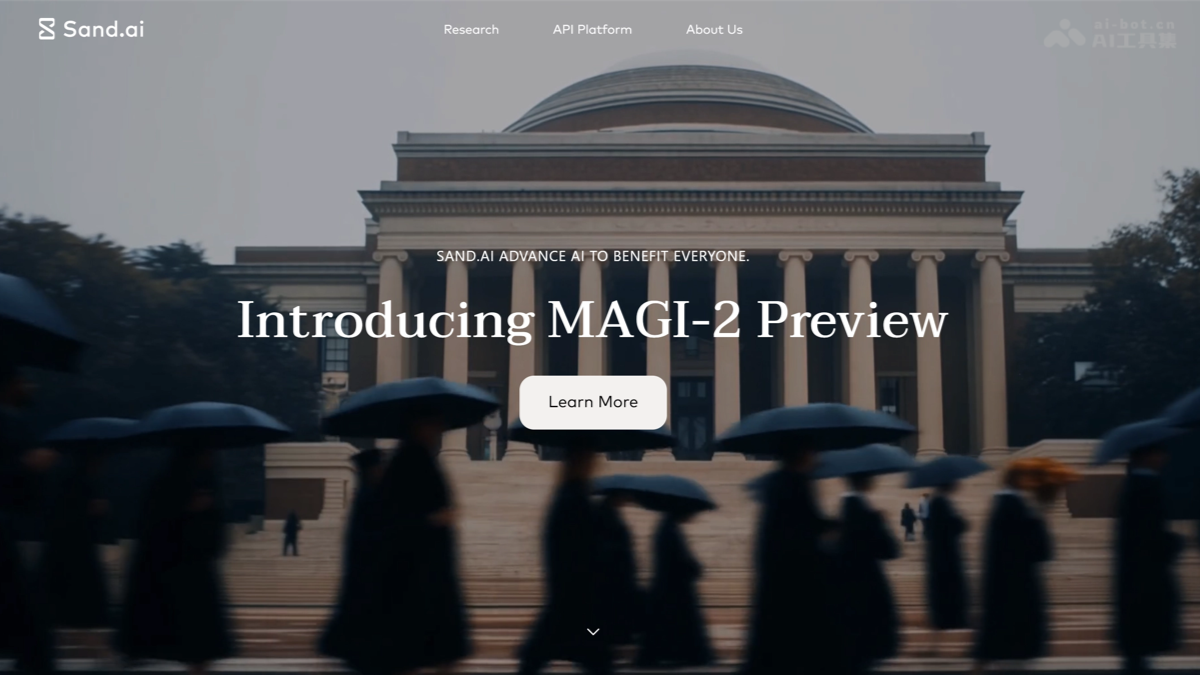
MAGI-2-preview is Sand.ai’s open-source, 100-billion-parameter MoE multimodal video generation model, with 114B total parameters and only 6B activated. The model retains a single-stream architecture that incorporates text, video, and audio into the same Transformer for joint modeling, enabling native multimodal generation. It ranks sixth on the AA video generation leaderboard. The model code and pretrained weights are now available, validating an efficient new Scaling path for video generation.
02Key Features of MAGI-2-preview
Multimodal video generation: Supports text-to-video, image-to-video, and video-to-video generation, with native audio understanding.
MoE sparse activation: Only 6B of the 114B total parameters are activated, significantly reducing inference costs.
Single-stream unified architecture: Replaces traditional cross-attention concatenation and jointly models visuals and audio from the first layer.
Efficient Scaling: Reconstructs MoE communication and training stability for video generation, addressing cross-device communication bottlenecks with extremely long sequences.
03How MAGI-2-preview Works
Follow WeChat and reply “开源” to join the AI open-source project discussion group.
MoE mixture-of-experts architecture: The model has a total capacity of 114B parameters, while only 6B parameters are activated in each forward pass, decoupling capacity from computation.
Single-stream Transformer: Text, video, and audio tokens enter the same Transformer from the input layer and exchange cross-modal information directly through self-attention, making it better suited than multi-tower concatenation architectures for capturing audio-visual synchronization details.
Distributed communication optimization: For the extremely long sequences characteristic of video, the token routing and communication strategies in expert parallelism were redesigned to reduce cross-GPU data transfer overhead.
Training stability solutions: A three-part stability mechanism combining dynamic routing, expert load balancing, and joint multimodal data training.
04How to Use MAGI-2-preview
Environment setup: Clone the GitHub repository SandAI-org/MAGI-2-preview and configure the dependencies according to the README.
Download the weights: Obtain the pretrained weights from GitHub Releases.
Run inference: Modify the configuration file and script parameters. The model supports t2v / i2v / v2v modes; refer to the MAGI-1 run.sh format for execution.
Hardware requirements: Specific configurations are pending updates to the official documentation. It is recommended to refer to the MAGI-1 setup with 24B on multiple H100 GPUs or 4.5B on a single GPU with 24GB VRAM.
05Core Advantages of MAGI-2-preview
Open source and commercially usable: The model uses the Apache 2.0 license, with fully open pretrained weights and inference code.
Pioneering 100-billion-parameter MoE: The world’s first successfully open-sourced 100-billion-scale MoE video generation model, validating a new Scaling path for video.
Low cost, high capacity: Activating only 6B parameters can drive a 114B model, delivering much lower inference costs than dense models of comparable scale.
Native multimodality: The single-stream architecture deeply integrates audio and video at the model’s foundation, avoiding the latency and quality loss caused by post-processing alignment.
06MAGI-2-preview Project Links
Official website: https://sand.ai/blog/magi-2-preview
GitHub repository: https://github.com/SandAI-org/MAGI-2-preview
HuggingFace model repository: https://huggingface.co/sand-ai/MAGI-2-preview
07MAGI-2-preview Use Cases
Long-form video advertising and short dramas: MoE’s large capacity supports complex narrative modeling and can generate coherent, minute-long story videos.
Multimodal film and television previsualization: Native audio understanding enables synchronized generation and editing of voiceovers, sound effects, and visuals.
Academic research on AI video: Open-source 100-billion-scale video MoE weights provide academia with a reproducible Scaling baseline.
Private enterprise deployment: Based on the Apache 2.0 license, the model supports organizations in sensitive industries such as finance and healthcare in building private video generation capabilities.
Real-time streaming generation: Sparse activation reduces inference costs and can support low-latency real-time video generation and livestreaming scenarios.
© Disclaimer: domains and linked content may change over time. AIEZZ does not control third-party websites. Review external content and risks independently.
User reviews0