

- Monthly visits
- 0
- Pricing
- Free & Paid
- Listed
- 2026-02-22
- Updated
- 2026-08-25
01Product Positioning
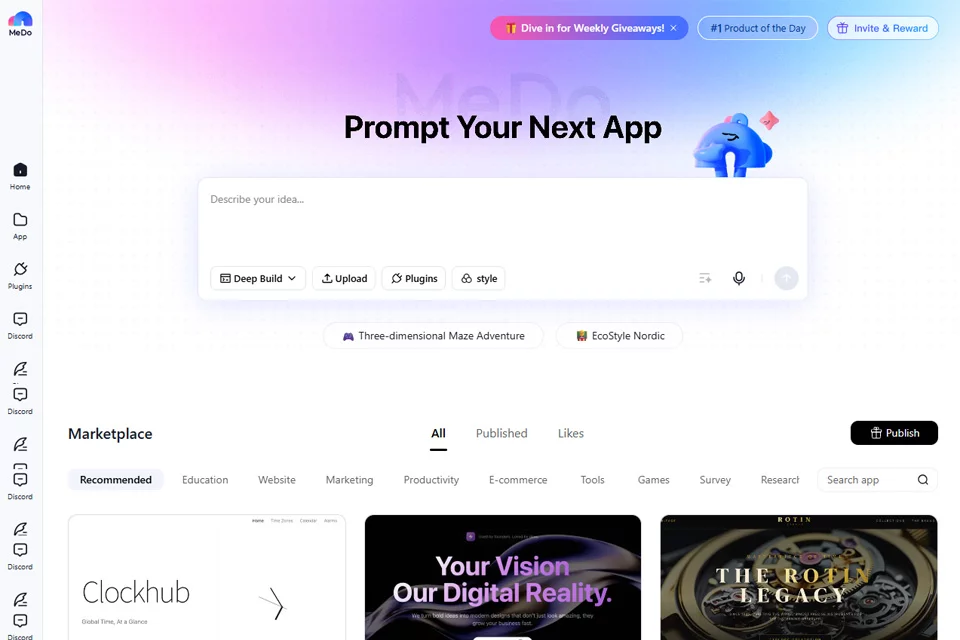
MeDo is positioned as a full-stack, no-code AI application-building platform focused on streamlining the work between describing a requirement and producing a runnable application. Users present their ideas in natural language, and multiple AI roles collaborate on planning, design, and coding across the frontend, backend, database, and deployment stages.
It is suitable for individuals and organizations that need to create applications or validate product directions quickly without a complete development team. The platform supports both conversational and drag-and-drop building, enabling users to generate applications from descriptions and then adjust their interfaces and functionality.
02Key Features
The platform can generate application interfaces, backend logic, and database structures from natural-language requirements, while providing built-in backend and database capabilities. Once an application is complete, it can be deployed directly, reducing server and runtime environment configuration work.
MeDo supports integration with more than 500 third-party services. Existing materials list modules such as Stripe payments, AI image generation, text-to-speech, and AI search. The platform also provides more than 100 application templates and supports AI-assisted issue diagnosis and fixes when errors occur.
03Use Cases
MeDo can be used to quickly create H5 pages, landing pages, surveys, mini-games, SaaS products, and internal business tools. It is also suitable for building lightweight applications such as data dashboards and customer management systems.
Entrepreneurs and product managers can use it to validate MVPs; operations, marketing, and design professionals can turn business ideas into applications; independent developers and freelancers can use it to create client projects; and small and medium-sized businesses can explore building internal workflow tools or customer-facing applications.
04Usage Considerations
Natural-language generation is suitable for quickly producing an initial version, but the completeness of the requirements description affects the application's structure and functionality. Projects involving payments, user management, business data, or complex permissions still require manual review of workflows, data processing, and exceptional cases.
AI-assisted fixes can reduce troubleshooting effort but cannot replace comprehensive testing. Before formal use, verify core functionality, database contents, and deployment status. Applications that will operate continuously also require plans for follow-up iterations and maintenance.
© Disclaimer: domains and linked content may change over time. AIEZZ does not control third-party websites. Review external content and risks independently.
User reviews0