
- Monthly visits
- 0
- Pricing
- Not set
- Listed
- —
- Updated
- 2026-09-18
01What Is Jev
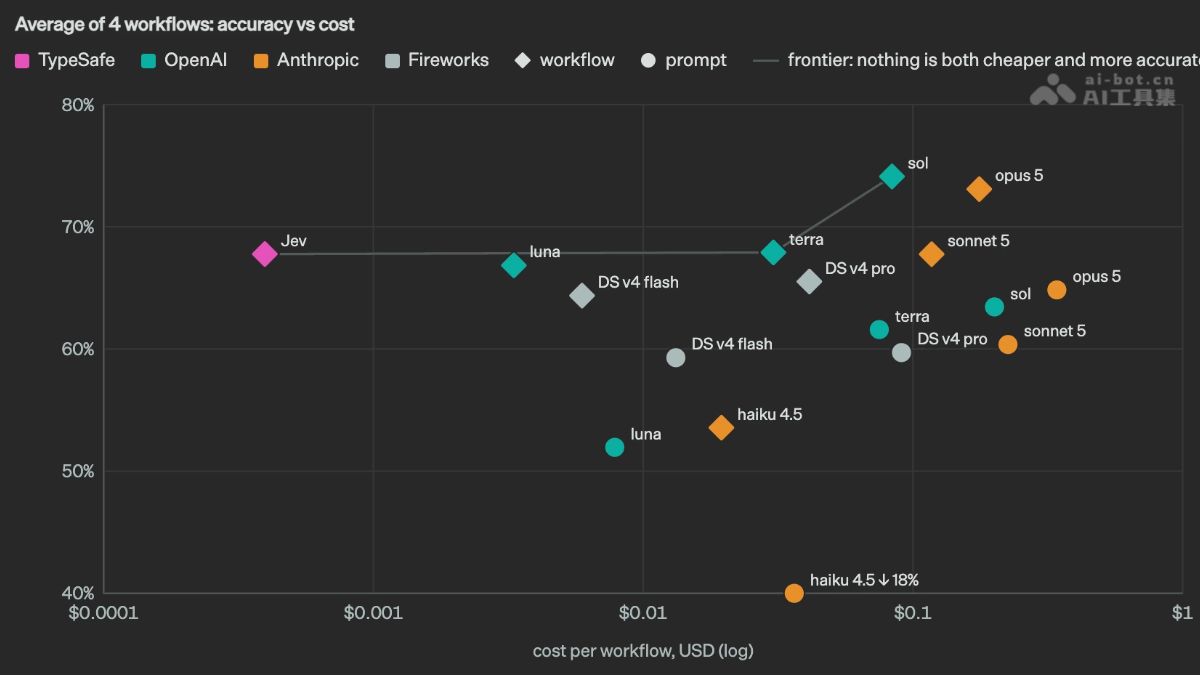
Jev is an AI structured decision model launched by TypeSafe AI. It does not chat, write code, or generate text. It does one thing: high-frequency decision-making. It takes unstructured information and, through a single parallel computation, instantly outputs structured judgments with calibrated probabilities. Latency is only 70–500 milliseconds; input costs $0.042 per million tokens, while output is free. The type error rate is 0%. The model serves as the pre-processing reflex arc for Agent systems, handling high-frequency judgments such as routing, classification, initial risk screening, and content filtering, allowing frontier models to focus on complex reasoning: a super decision-maker with world knowledge.
02Jev's Main Features
Structured decision output: The model returns only Choice, Score, or Noul (Boolean judgment) values within predefined types, along with calibrated probabilities.
Parallel multi-path judgment: A single call can answer multiple independent questions simultaneously, with latency that does not increase linearly with the number of questions.
Confidence-based routing: Automatically routes decisions by calibrated confidence: high-confidence results execute directly, medium-confidence results go to a large model for review, and low-confidence results are sent to a human.
Agent pre-filtering layer: Handles frequent small decisions such as routing, classification, verification, and status checks, reducing expensive large-model calls by more than 90%.
Zero-format-error guarantee: Outputs are strictly constrained to the predefined Schema, making the type error rate mathematically 0% and allowing direct integration into code pipelines.
Millisecond real-time judgment: With 70–500 millisecond responses and a cost of about $0.0004 per decision, AI can enter latency-sensitive scenarios such as game operations, real-time content filtering, and trading decisions for the first time.
03How Jev Works
Eliminating autoregression in favor of parallel sampling: Traditional LLMs generate tokens sequentially, so longer outputs require more decoding steps. Jev uses a proprietary parallel sampler to produce all judgment results simultaneously in a single forward pass, without decoding character by character.
Constrained output space: Developers predefine a Schema, such as refund_risk={low, medium, high}. The model assigns probabilities only among these options, trading flexibility for efficiency. Outputs are always parseable and directly consumable by code, eliminating format hallucinations and type errors by design.
RLCD training: Reinforcement Learning for Calibrated Decisions. RLHF optimizes human preferences, and RLVR optimizes verifiable answers. RLCD optimizes whether a judgment is correct and whether the model's stated confidence is honest. When the model reports 90% confidence across a batch of tasks, approximately 90% should actually be correct. This is the mathematical foundation for automated routing.
Confidence as an interface: Every output includes a calibrated probability. Software routes by threshold: >0.90 executes automatically, 0.7–0.9 goes to a large model for review, and <0.7 is sent to a human, making uncertainty explicit to the system.
04How to Use Jev
Apply for Early Access: Visit the TypeSafe AI website at https://typesafe.ai/, join the waitlist, and, once approved, obtain an API key at console.typesafe.ai.
Try the Playground: In the Console Playground, configure questions and define the output Schema to see decision results with probabilities.
Define a Schema: Use JSON to declare the questions to be judged and their types in advance (Choice/Score/Noul and their options). This is the only required preparation before making a call.
Call the API: Send a POST request to https://api.typesafe.ai/v1/systemone, set the model ID to jev-latest, provide unstructured content, and receive structured judgments with calibrated probabilities.
Use the official SDKs: Install typesafe-sdk for Python or @typesafe-ai/sdk for JS/TS to automatically handle request construction and type validation.
05Jev's Key Advantages
Extreme latency: End-to-end responses in 70–500 milliseconds, 40–200 times faster than frontier models, enabling AI judgment in real-time scenarios for the first time.
Extremely low cost: Input costs $0.042 per million tokens, output is free, and each decision costs about $0.0004, making it up to 444 times cheaper than GPT.
Zero format errors: Outputs are strictly constrained to the predefined Schema, making the type error rate mathematically 0%.
Calibrated confidence: Every judgment includes an honest probability through RLCD training. Systems can route automatically by threshold, providing the mathematical foundation for automation.
Parallel multi-path judgment: A single call answers multiple independent questions simultaneously, with latency that does not grow linearly with the number of questions.
General semantic ability retained: Unlike traditional classifiers, Jev can handle new tasks zero-shot without retraining for each type of judgment.
06Jev Project URL
Project website: https://typesafe.ai/blog/introducing-system-one-models-and-jev
07Jev Use Cases
Content filtering and recommendation pre-screening: Real-time folding of inflammatory or advertising content in information feeds, or AI relevance pre-screening for tens of thousands of crawled items, leaving only fine screening to expensive models.
Ticket routing and customer service triage: A single email can be evaluated for assignment department, urgency, refund risk, and whether human intervention is needed. High-confidence tickets are processed automatically.
Initial risk and compliance screening: Assign risk levels and output probabilities for transactions, credit, and UGC content. High-confidence cases are approved automatically, while low-confidence cases are sent to humans or stronger models for review.
Agent pipeline decision layer: Handles frequent small judgments such as tool selection, result ranking, status checks, and whether to terminate, reducing expensive large-model calls by more than 90%.
© Disclaimer: domains and linked content may change over time. AIEZZ does not control third-party websites. Review external content and risks independently.
User reviews0