
- Monthly visits
- 2
- Pricing
- Free
- Listed
- 2026-06-23
- Updated
- 2026-08-25
01Product Positioning
vly brings product ideation, code generation, and application publishing into a single conversational workflow. Users start by describing their requirements in natural language, while the AI asks follow-up questions and iterates on the project based on feedback, generating React, Vite, and Convex applications with interfaces, backends, and databases.
It is best suited to entrepreneurs, product professionals, operations teams, and development teams that need to quickly validate a business workflow. Compared with tools that only generate static pages, vly extends its scope to full-stack projects and deployment.
02Key Features
vly supports generating and modifying web applications through natural language, along with project previews, continuous iteration, and real-time team collaboration. Its technology stack includes React, Vite, and Convex, which can be used to organize frontend, backend, and database components.
For project management and publishing, the tool supports version checkpoints and rollback, custom domains, and application deployment. These capabilities help preserve milestones during experimentation and publish projects as accessible online versions.
03Use Cases
Entrepreneurs and independent developers can use it to build early versions of SaaS products, admin dashboards, or small products, first validating feature flows and business direction. Product managers and operations teams can create campaign pages, internal tools, or demonstrable prototypes to support team discussions about requirements.
Development teams can first generate React, Vite, and Convex projects, then continue adjusting features, data structures, and interfaces. Real-time data dashboards, collaborative boards, and multiplayer interactive applications are also within its scope.
04Usage Considerations
Conversational generation does not mean a project is completed in one step. The more complex the requirements, the more important it is to clarify features, data relationships, and page behavior through multiple rounds of description and confirmation. Generated code and application workflows should still be reviewed, tested, and modified by the user.
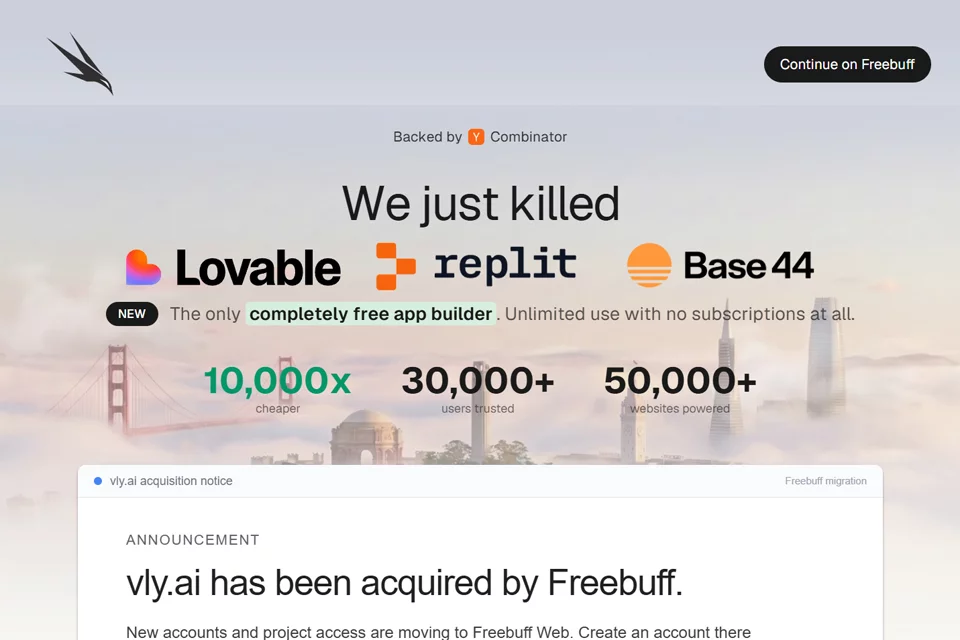
Users should also pay attention to changes in the product's access point: vly has been integrated into Freebuff, and account and project access will subsequently migrate to Freebuff Web. When organizing projects, sharing URLs, or coordinating collaboration, teams should use the migrated access point.
© Disclaimer: domains and linked content may change over time. AIEZZ does not control third-party websites. Review external content and risks independently.
User reviews0