
- Monthly visits
- 0
- Pricing
- Free & Paid
- Listed
- 2026-08-10
- Updated
- 2026-08-10
01What Is WorldClaw?
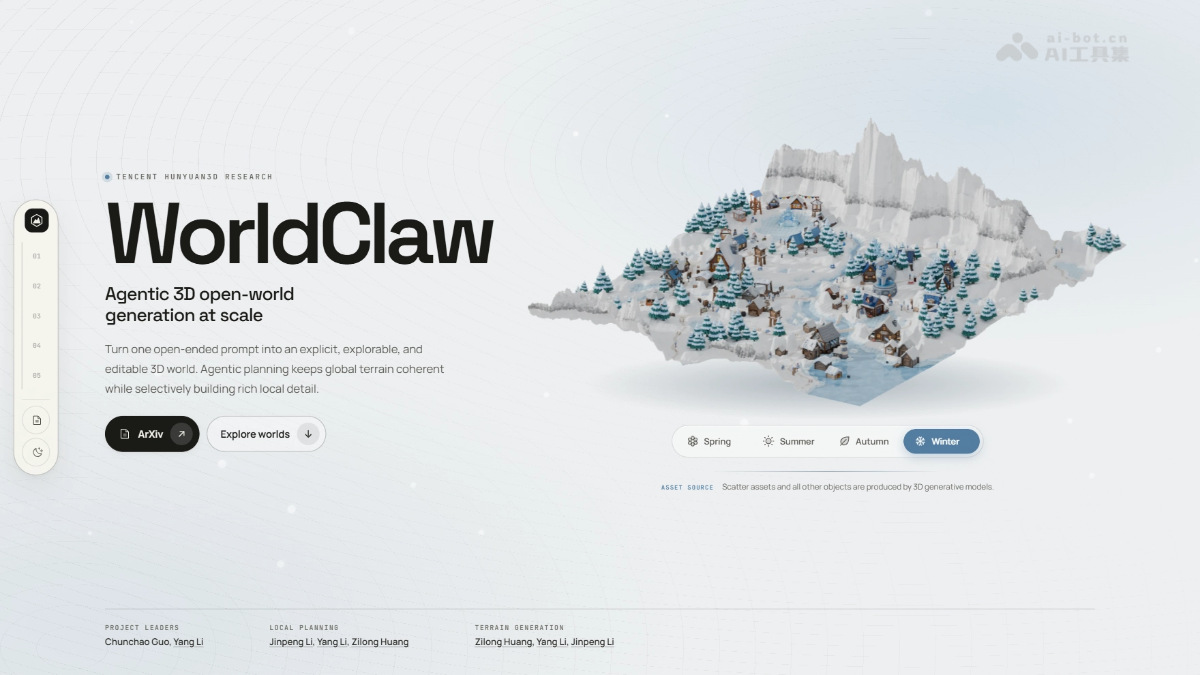
WorldClaw is an Agent-driven open-world 3D generation framework developed by the Tencent Hunyuan team. With a single natural-language description, the system automatically plans terrain, regions, buildings, objects, and spatial relationships. Using a coarse-to-fine generation strategy, it builds complete 3D scenes in Blender that can be freely explored and edited object by object. The framework is powered by multiple collaborating models, including Claude Opus, GPT-Image-2, SAM3, and Hunyuan3D. It also features visual Agent-based self-checking and repair, automatically correcting contact issues such as floating objects and mesh intersections.
02Key Features of WorldClaw
Intelligent scene planning: The planning Agent analyzes the user's description and converts open-ended prompts into structured scene specifications containing regions, terrain, objects, materials, and spatial relationships.
Coarse-to-fine generation: The system first establishes the world's terrain and spatial framework, then progressively fills in details for each region to avoid broken roads and inconsistent scale.
Independent asset generation: Objects such as buildings, vegetation, and vehicles remain independent instances rather than a single baked model, allowing them to be moved, replaced, and edited individually.
Visual self-checking and repair: The visual Agent renders the scene from multiple viewpoints to check proportions, poses, and contact issues, automatically fixing defects such as floating objects and mesh intersections.
Deep Blender integration: The entire workflow, including terrain generation, asset generation, scene placement, checking, and rendering, runs in Blender 5.1.1 and supports MCP interface operations.
03How WorldClaw Works
Multi-Agent collaboration architecture: The system consists of a planning Agent, scene optimization Agent, and visual inspection Agent, responsible for scene design, Blender operations, and quality validation respectively.
Model specialization: Claude Opus 4.8 serves as the foundational Agent model, GPT-Image-2 handles image generation, SAM3/SAM3D handles segmentation, and Hunyuan3D handles 3D reconstruction and asset generation.
Coarse-to-Fine generation strategy: The system first generates a semantic height field to establish the terrain skeleton, then generates object composition plans by region, and finally reconstructs individual 3D assets and combines them.
Local repair mechanism: For contact issues, the system modifies only the corresponding support area, avoiding damage to the overall terrain structure.
04How to Use WorldClaw
Enter a description: Describe the desired open-world scene in natural language.
Intelligent planning: The planning Agent automatically decomposes the prompt and generates a structured scene specification containing regions, terrain, objects, and spatial relationships.
Generate the terrain skeleton: The system generates a semantic height field to establish the spatial foundation for terrain regions such as mountains, rivers, and coastlines.
Generate regional assets: Buildings, vegetation, vehicles, and other independent 3D assets are generated by region and placed in their corresponding locations.
Visual inspection and repair: The visual Agent renders the scene from multiple viewpoints and automatically fixes issues such as abnormal proportions, floating objects, and mesh intersections.
Export and edit: Obtain the complete scene in Blender and freely adjust object positions, replace assets, or modify materials.
05Core Advantages of WorldClaw
From prompt to complete world: A single natural-language description can automatically produce a complete, explorable 3D scene containing terrain, buildings, vegetation, and facilities, without manually modeling each asset.
Independently editable assets: All objects retain independent textured meshes and instances, allowing them to be moved, replaced, or have their materials modified individually without regenerating the entire world.
Intelligent self-checking and repair: The visual Agent proactively checks proportions, poses, and contact issues, automatically fixing common 3D defects such as floating objects and mesh intersections to improve generation quality.
Deep Blender integration: The entire workflow runs in Blender 5.1.1 and supports direct operation through the MCP interface, making it easy to integrate with existing 3D workflows.
06WorldClaw Project Links
Project website: https://tencent-hunyuan.github.io/Hunyuan3D-WorldClaw/
arXiv technical paper: https://arxiv.org/pdf/2608.05248
07Applications of WorldClaw
Game prototyping: Quickly generate open-world level blockouts and concept scenes to accelerate early gameplay validation and iteration.
Virtual production for film and television: Build large-scale virtual environments for location shoots, supporting director shot previews and digital asset previsualization.
VR/AR experience design: Generate immersive, freely explorable 3D spaces for virtual tourism, training simulations, or exhibitions.
Architecture and urban planning: Visualize large-scale regional planning proposals and clearly present the layout of terrain, buildings, and public facilities.
3D creative concept art: Provide designers with an editable foundation for complete scenes, significantly reducing the cost of building environments manually from scratch.
© Disclaimer: domains and linked content may change over time. AIEZZ does not control third-party websites. Review external content and risks independently.
User reviews0