

- Monthly visits
- 0
- Pricing
- Free
- Listed
- 2025-07-30
- Updated
- 2026-08-25
01Product Positioning
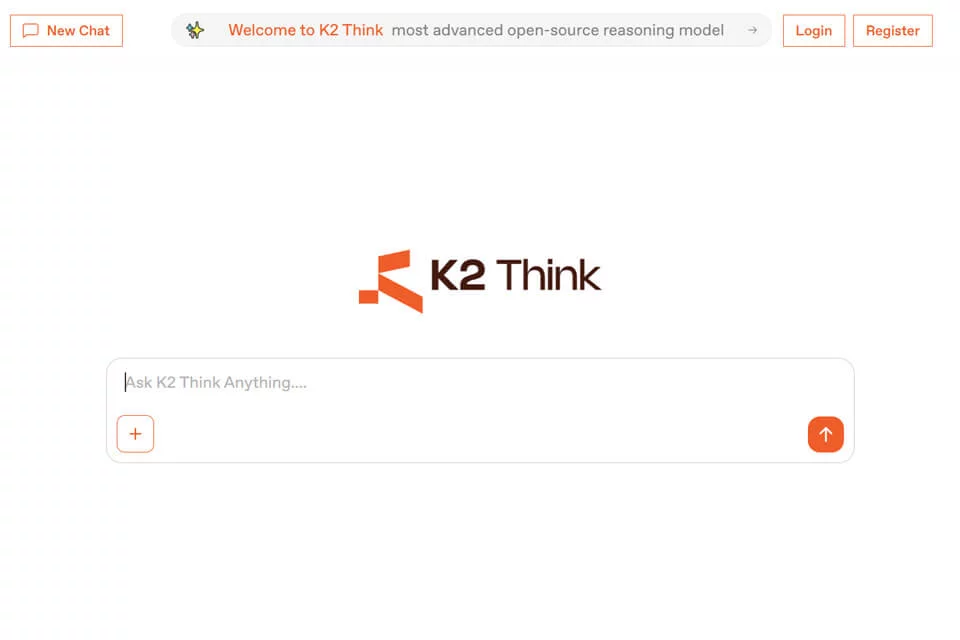
K2 Think is designed for AI conversational scenarios that require analysis and reasoning, with a focus on complex logic, mathematical problems, and professional knowledge Q&A. Jointly launched by Mohamed bin Zayed University of Artificial Intelligence in the UAE and G42, it is an open-source reasoning model.
The model has 32 billion parameters. Product materials highlight its parameter efficiency and inference speed, making it suitable as a conversational assistant for research, learning, and development work.
02Key Features
K2 Think supports mathematical reasoning, code generation, and Q&A in scientific fields such as physics and chemistry. For questions that require conditions to be broken down, processes to be explained, or follow-up discussion, users can obtain analysis through multi-turn conversations.
Available materials state that its inference speed can exceed 2,000 tokens per second. The model also includes safety handling for high-risk requests, so some requests may be refused.
03Use Cases
Developers can use it for writing code, understanding algorithms, and analyzing technical issues. Researchers can use it to organize materials and discuss ideas in areas such as mathematics, physics, and chemistry. Educators and students can use it for programming study, explaining complex concepts, and analyzing exercises.
Work requiring substantial logical processing, such as financial modeling and scientific computing, can also use K2 Think for preliminary analysis and Q&A support. However, it should not directly replace professional review or final decision-making.
04Usage Considerations
Generated code, formulas, derivations, and professional conclusions may contain errors. Before use, they should be verified against original materials, test results, or professional advice. In particular, outputs should not be adopted without review in research, finance, and educational assessment.
Current materials do not specify deployment requirements, context length, or full interface capabilities. Before using the model in formal business operations, confirm the access method, computing requirements, data-handling process, and the team's operational capabilities.
© Disclaimer: domains and linked content may change over time. AIEZZ does not control third-party websites. Review external content and risks independently.
User reviews0