


When many beginners first start working on AI comic dramas, what they are most enthusiastic about is often not refining the story, but scouring the internet for all kinds of so-called universal prompts.
From detailed character traits and visual styles to camera parameters, lighting quality, and even rendering engines, they wish they could cram several hundred words of prose into the generation box all at once.
Strangely enough, their prompt collections are packed, they adjust the parameters over and over, and the generated images do not look bad—but in the end, nobody watches the comic dramas they edit.
Views are dismal, and the completion rate is even more pitiful.
Where exactly does the problem lie?
The answer is actually quite simple: they vastly overestimate the role of prompts and completely misunderstand the real competitive threshold in the AI comic drama space.
AI comic dramas have never been about whose Prompt is longer or whose parameters are more complicated. What truly separates creators is whether they possess systematic directorial thinking.
Many people are accustomed to treating prompts like mathematical formulas, believing that as long as they apply the structure of “subject + action + setting + style + lighting,” they can calculate the perfect answer like solving a math problem.
But prompts are neither formulas nor do they have a universal template that works forever.
There is only one underlying principle: precisely translate the invisible images and emotions in your mind into physical elements that AI can understand.
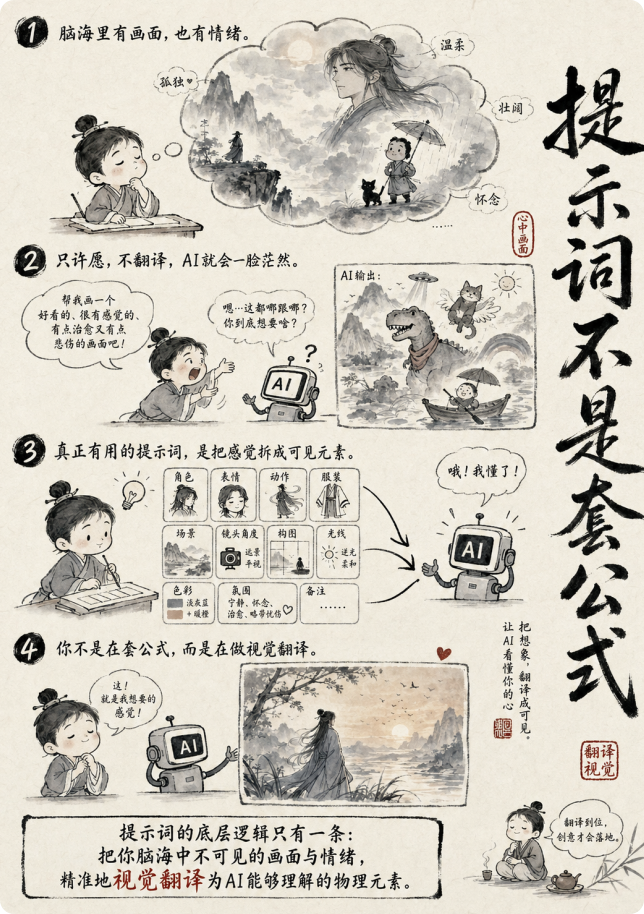
When expressing emotions, humans rely heavily on abstract words such as loneliness, despair, repression, and ambition.
When someone hears “a person who has lost hope standing in the rain at night,”
the brain automatically draws on life experience to fill in that person’s hollow gaze, hunched back, icy rain, and the seemingly endless nighttime street.
But AI models based on data distributions and probability calculations cannot do this.
Giving it an abstract word directly is like asking a camera to capture “sadness” itself. The camera has no idea where it should point.
A truly effective prompt is an extremely rigorous on-set directing sheet.
If you want to express “loneliness,” you must never write “a lonely person,”
but instead translate it into: “An empty street late at night, a single person standing alone in the pool of light beneath a streetlamp, back to the camera, shoulders slightly drooping, surrounded by expansive darkness.”
If you want to convey “frustration,” you cannot simply write “he feels very depressed,”
but should translate it into: “Plans scattered across a chaotic desk, a man supporting his forehead with his hands clasped together, his body sunk into the shadows, while a cool white fluorescent light from above falls on the disordered desktop.”
If you want to portray “ambition,” you should not write “an ambitious look in his eyes,”
but translate it into: “A low-angle shot looking upward, the character standing before the glass curtain wall of a skyscraper and looking down at the flowing traffic below, side backlighting outlining a sharp silhouette, body upright, chin slightly raised.”
See the difference?
Breaking down invisible emotions into concrete “character poses, camera angles, environmental details, and lighting distribution” is not merely a prompt technique—it is a director conducting visual blocking on set.
Furthermore, even if you master visual translation and can generate a single extraordinarily striking image, that does not mean you can make an episode of a comic drama that becomes a hit.
Because a single image is a static illustration,
while a comic drama is an audiovisual art form built on time, sound, and shot transitions.
When AI reduces the cost of creating images and producing moving footage to nearly zero, beautiful visuals themselves are no longer scarce assets. The real competition has long since moved up to control of audiovisual language.
What determines whether a comic drama can retain its audience
is first and foremost the construction of dramatic structure.
AI can instantly help you draw “a young person whose startup has failed,”
but viewers will not stay for a pretty face. They want to know why this young person failed, who drove him into dire straits, and at what point he will strike back.
Ordinary content merely mechanically presents a sequence of events, while viral content is always creating conflict, contrast, and suspense. That is the difference between professional and nonprofessional work—not that you necessarily have to learn a huge amount of specialized knowledge.
“A young person’s startup failed” is bland information, whereas “After graduating from college, he returned to his village to raise pigs and was mocked by the entire village, but three years later, the people who once mocked him lined up to ask for partnerships” has the narrative tension that grabs people.
What determines view counts has never been whether the pigs look realistic enough,
but whether viewers want to know what he will do next.
Next comes the orchestration of visual language.
The mistake beginners make most easily is trying to explain everything in one information-overloaded wide shot, resulting in flat, uneventful visuals.
Creators who understand visual language use combinations of shots to progressively build emotion:
First, use a long shot to show the vastness of the environment and the character’s smallness, creating a sense of oppression; then cut to a medium shot to present the interaction between characters and the collision of events, advancing the plot; finally, use a close-up to focus on a character’s subtle expression, twitching fingers, or a key prop, triggering emotional resonance.
For example, to show the protagonist being fired: one wide shot of the office, one medium shot of the boss pushing a dismissal letter toward him, and one close-up of the protagonist crumpling the paper beneath the desk.
The visual tension created by this three-shot combination far surpasses that of any single beautiful image.
Finally, there are editing rhythm and negative space.
If AI-generated visuals are presented in a flat, straightforward manner, they can easily feel slow and mechanical.
Experts know how to subtract with visuals and add with editing.
To show the protagonist trapped in a desperate situation, there is no need to film him crying in a room for several minutes. Instead, quickly cut between three shots: the balance in his mobile banking app showing zero; his elderly father quietly placing a bankbook on the table while he is not looking; and, late at night, him tearing the resignation statement he has written into shreds.
None of these images contains the word “despair,”
yet the weight of that emotion hits the audience head-on.
Now that AI models are so powerful, the creator skill hierarchy has already undergone a complete transformation.
At the bottom is AI expressiveness, namely basic Prompt writing and character consistency control.
Above that is post-production, including editing to the beat, BGM, and sound-effect design.
One level higher is the use of visual language.
At the very top are always story selection, conflict design, and emotional control.
All of these are extensions and manifestations of directorial thinking.
If you think I am talking nonsense, try searching for the storyboard manuscripts of renowned directors.
I know some people will be too lazy to do that, so I found one and pasted the link below:
https://www.6pian.cn/news/7589.html
These storyboard manuscripts all demonstrate one thing:
Directors know exactly what they want to express, and they have extremely clear images in their minds.
The emergence of AI has lowered the physical barrier to producing visuals, but it has not solved the problems of “what to shoot,” “why shoot it this way,” or “why should the audience keep watching.”
In the past, a creator with a brilliant story in mind might have regretfully abandoned the idea of making an animation because they could not draw or lacked a budget, turning instead to writing a novel.
But now, AI has put photography, art, actors, and editing tools into everyone’s hands.
Equal access to visual expression has been effortlessly achieved through AI.
But no matter how powerful the tools are, you still need to know where to position the camera, which angle the light should come from to best match the emotion, and when to decisively call “Cut.”
Otherwise, even if you memorize tens of thousands of parameters and universal templates, you still will not be able to accurately break down the world in your mind into individual shots with conflict, rhythm, and emotional impact.
Of course, for those who do not want to study and only want ready-made solutions, I have prepared a bonus as well.
I managed to get hold of this fresh Minimax H3 prompt library.

URL: https://cheerselfai.com/prompts/minimax-h3